
















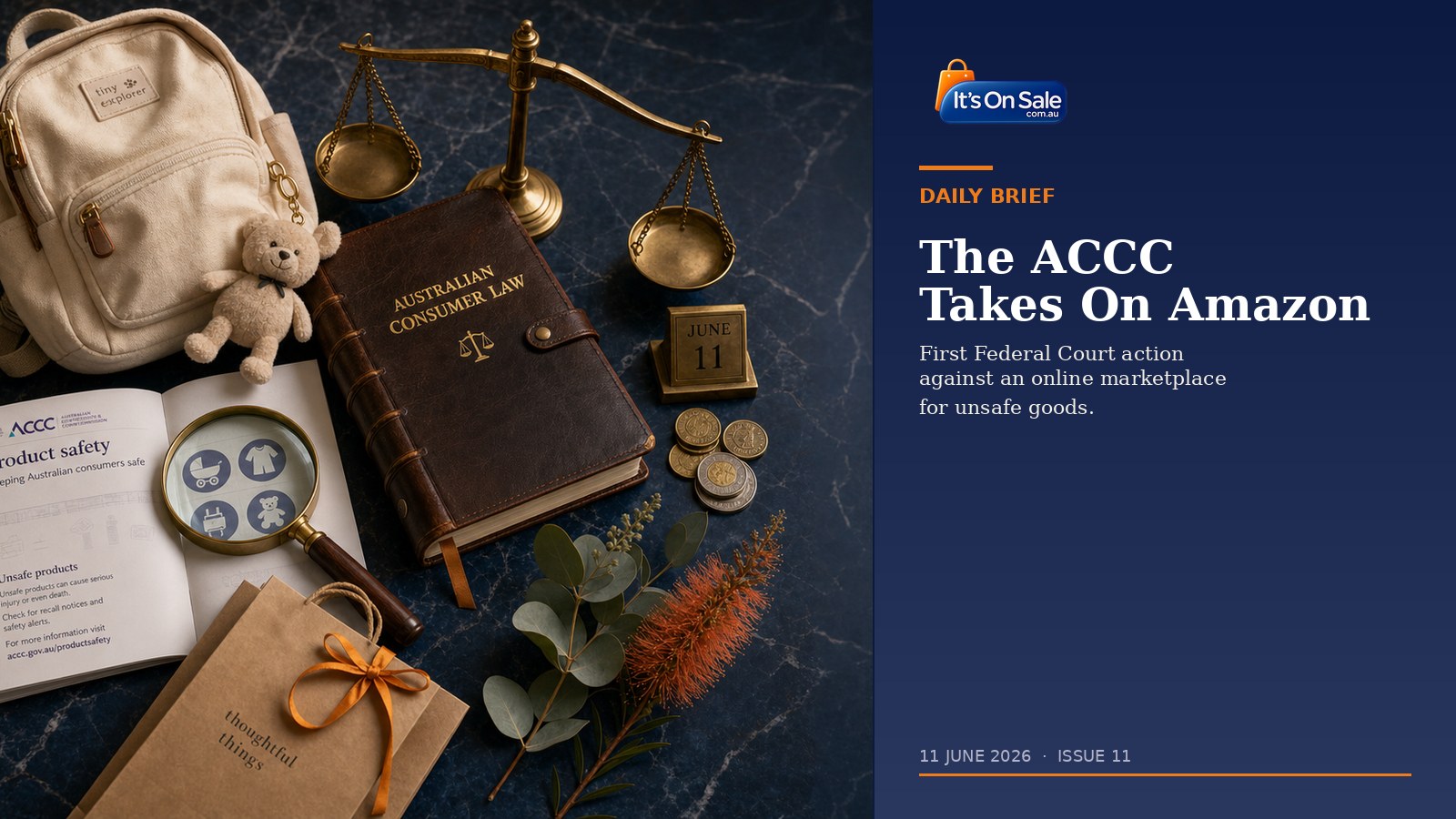

Cheapest is not safest. The ACCC has just dragged Amazon into the Federal Court over kids’ backpacks that sat in its Australian warehouses without the warning labels mandatory product safety law requires. It is the first time the watchdog has taken an online marketplace to court for failing the rules that govern every other Australian retailer. Read it alongside this morning’s Westpac consumer sentiment print, which sank to 80.6, and a clearer picture emerges. Australian shoppers are tighter than they have been since April, the offshore funnel is under regulatory scrutiny, and EOFY 2026 has nineteen trading days to run. 35,000 Aussie stores. One search. That is the offer this week.
The ACCC Takes Amazon To Federal Court
On 29 May the Australian Competition and Consumer Commission filed Federal Court proceedings against Amazon Commercial Services Pty Ltd, the local Amazon entity, over Unicorn Toddler Backpacks listed on amazon.com.au through a third-party seller. The backpacks contained a detachable light-up unicorn plush toy powered by a button battery, and the ACCC alleges the products and their outer packaging carried none of the warnings the Consumer Goods (Products Containing Button/Coin Batteries) Information Standard 2020 makes mandatory. The case is filed as NSD905/2026 in the New South Wales Registry.
The numbers in the concise statement are small but the principle is enormous. The ACCC alleges 41 backpacks were sold to Australian consumers through the marketplace and 267 backpacks were held in Amazon’s Australian fulfilment centres as of 1 November 2022. Crucially, the watchdog argues that under section 136(3) of the Australian Consumer Law, mere possession or control of non-compliant goods (the receiving, storing, picking, packing and shipping that Amazon does for third-party sellers under Fulfilment by Amazon) is enough to put the marketplace itself on the hook. That neatly sidesteps the long-running argument over whether marketplaces are suppliers or just middlemen.
This is the first time the ACCC has taken an online marketplace to the Federal Court over a mandatory product safety standard. Catriona Lowe, ACCC Deputy Chair, framed the consumer stakes: “Button batteries pose a serious hazard for young children. If swallowed or inserted, they can cause severe internal burns and injury, and in some cases death.” On the marketplace question she added: “Many Australian consumers now shop on online marketplaces. That’s why it is important that consumers have confidence and trust in digital markets.” The ACCC is seeking declarations, penalties, costs and other orders, and David Braue at Information Age notes that unsafe products in digital markets sit explicitly inside the watchdog’s 2026/2027 enforcement priorities.
Why This Lands Differently For Shoppers
The case lands in a market where Choice already did the awkward homework. In late November the consumer group bought 24 button-battery products from Amazon, Shein, eBay, AliExpress and Kogan and 17 of the 24 failed the mandatory standards, the result reported across Information Age and now sitting alongside Choice’s “super complaint” to the ACCC, which the regulator must respond to within 90 days. The ACCC’s own 2023 surveillance pegged 34 per cent of products containing button batteries as missing mandatory warnings. Each one of those products quietly went out the door before anyone in fulfilment caught the gap.
For consumers the practical read is this. The big offshore marketplaces are now under simultaneous pressure from the regulator (Federal Court action plus takedown notices), a consumer advocacy group (Choice’s super complaint, which targets Amazon, eBay, Kogan and Fruugo by name), and the political class (multiple Senate references on online product safety in the last six weeks). None of that is a reason to panic about every Amazon order. It is a reason to know what protections sit behind whichever store you are buying from when the product is going to a child.
Australian-owned retailers carry the same mandatory standards by default and are routinely audited by state and territory consumer protection agencies. They also tend to ship from inside the country, which means returns are short, recall notices reach you, and customer-service answers a phone. That is not a marketing claim. That is the structural difference between buying from a marketplace and buying from a retailer.
Consumer Sentiment Sinks Again Ahead Of EOFY
The second number worth pinning to the fridge today is the June Westpac-Melbourne Institute Consumer Sentiment Index. Westpac IQ published the print at 80.6, a 2.9 per cent fall from May and back near the deep-pessimism territory the index has not climbed out of since the start of the year. Matthew Hassan, Westpac Senior Economist, summarised it directly: “Cost-of-living issues came back with a vengeance in June.” The two sub-indices that map most tightly to retail spending both fell harder than the headline. The “family finances vs a year ago” reading dropped 7.5 per cent to 67.3, and “family finances over the next 12 months” dropped 8.5 per cent to 85.1, both giving back almost all of the gains they posted in May.
Layer that on top of the RBA cash rate at 4.35 per cent following May’s hike, and the picture is a consumer wallet that is open for value but closed for impulse. Hassan summed up the mood: “Australian consumers are clearly bracing for more bad news on the financial front.” Retailers reading this morning’s tape will be pricing the back half of EOFY 2026 accordingly, and the deepest discount tags of the financial year traditionally arrive in the final fortnight. That fortnight starts on Monday.
Top 5 Deals of the Day
Today’s catch. Five Australian-owned or AU-stocked stores, five categories, all rotated fresh. Yesterday’s leaders are cooled down; the hunter never works the same patch two days running.
Discount
 CostumeBoxCostumes & PartyUp to 75% off CostumeBox’s clearance: kids’ dress-up, adult party, school book-week and Halloween prep from the Australian-owned costume specialist, dispatched from its Melbourne warehouse.75%OFF2
 Graham'sJewelleryUp to 70% off Graham’s Jewellers’ sale: diamond rings, gold pendants, watches and gifts from the family-owned Australian jeweller trading since 1922, with showrooms across the country.70%OFF3
 GlassonsWomen's FashionUp to 63% off Glassons’ sale: denim, knits, dresses and basics from the Australasian-owned label with stores across the east coast and free AU shipping over $75.63%OFF4
 NovoShoesUp to 60% off Novo’s sale: heels, flats, boots, sandals and bags from the Australian-owned footwear chain with stores in every state and free Click & Collect.60%OFF5
 Original Mattress FactoryFurnitureUp to 60% off Original Mattress Factory’s Cloud-9 range: queen and king mattresses with free metro delivery, made by the Australian-owned manufacturer based in Sydney.60%OFF
% discounts shown are indicative across each store’s sale range. Individual product savings vary.
Other Deals Worth a Look
Two deeper headline numbers in the pool today did not make the Top 5 because the categories were already filled or because the store has been rotated out under our three-day cooldown rule, but they earn a look. Showpo is at 60 per cent off on dresses, knits and party wear from the Sydney-founded label. Strandbags is also at 60 per cent off on Samsonite, American Tourister and its own luggage and handbag lines, with free Click & Collect at any of its 230 Australian stores. Both Australian-owned, both locally fulfilled.
The Counter-Funnel
So here is the brief, plainly.
The offshore funnel is real. It is fast. It is one click away. And as of last week it is also a defendant in the Federal Court of Australia over the kind of safety warning that every other Australian retailer has been quietly printing on packaging for four years.
What the day’s tape does not show is the other map. The one with 35,000 Australian retailers on it. Stores that hire locally. Stores that stock locally. Stores whose customer-service team you can reach by phone on a Tuesday. They are not absent from the internet. They are scattered across it.
That is the problem It’s On Sale was built to solve. Not to compete with Amazon on velocity. Not to out-distribute Temu. To do the one thing the offshore funnel cannot do, which is surface every genuine Australian sale, from every Australian store, in one search, every day, before lunch.
35,000 Aussie Stores. One Search. That is the offer. That is the whole offer.
The ACCC case will play out over months. Consumer sentiment will move. The funnel will keep tilting. We will keep doing what we do, which is auditing the Australian retail pool at dawn, ranking the deepest live deals, publishing the brief by 9am, and keeping the door open to every Aussie store that wants to be found.
This is the counter-funnel. It is already built. It is already here. It’s On Sale.