















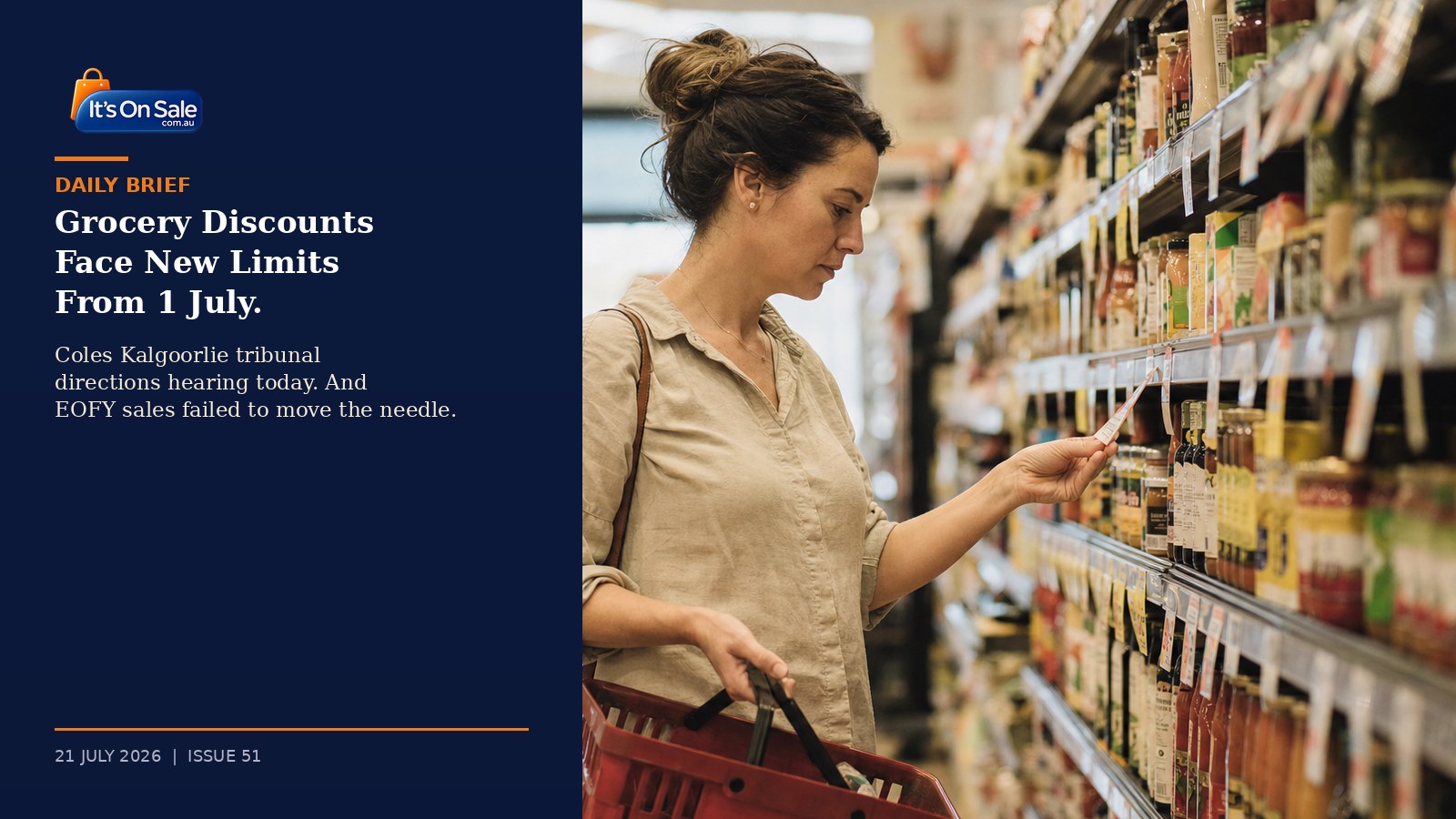

Tuesday morning and the ground rules of the Australian supermarket aisle have quietly changed: since 1 July 2026 it has been illegal for Coles and Woolworths to charge prices that are significantly excessive compared to their own cost of supply plus a reasonable margin, with maximum penalties of $10 million per breach. Today, Coles walks into the Australian Competition Tribunal for the case management hearing on its appeal against the ACCC block on a second Kalgoorlie supermarket, the first live test of the new merger regime effective 1 January 2026. Fresh CommBank and NAB data confirm what most household budgets already knew: EOFY sales failed to move the needle in June, with recreation spending decelerating from 2.3 per cent growth in May to 0.2 per cent. Tuesday’s Top 5 opens with Princess Polly at up to 80 per cent off.
Grocery Discounts Now Have To Be Economically Justified
Under the new excessive pricing provisions of the Food and Grocery Code of Conduct, which took effect on 1 July 2026, it is now illegal for a very large supermarket (defined as one with annual revenue above $30 billion, which currently means only Coles and Woolworths) to charge prices that are significantly excessive when compared to the cost of supplying the product plus a reasonable margin (Australian Associated Press coverage via news.com.au, 20 July 2026). The rules were legislated in response to two years of consumer outrage over grocery prices, the ACCC 2024-2025 supermarket inquiry, and repeated Senate hearings during 2025 where both major chains defended their margins under sustained questioning.
Cost of supply, as defined in the new provisions, can include what the supermarket pays to buy or produce the item, transport and logistics, staff wages, store rent, research and development, and investment in equipment or technology. The reasonable margin is not fixed at a single percentage, it depends on what is reasonable in the circumstances of the individual product, and it will be tested case by case if a breach is alleged. Maximum penalties sit at $10 million per breach, or three times the benefit obtained, or 10 per cent of annual turnover in Australia, whichever is greatest. Only the ACCC can bring a proceeding under the code; consumers cannot sue directly, which is a point the government has flagged to review after the first twelve months.
Practical shopper read: at Coles and Woolworths, expect the era of the mystery 50 per cent off ticket on a $2 tin of tomatoes to be quietly retired. Discounts will still exist, they will still be aggressive on genuinely overstocked or short-dated stock, but the eye-watering percentage claims that were partly a product of an inflated pre-discount ticket price are now legally risky. If you have watched a product cycle between $6 full price, $3 half price, $6 full price for eighteen months, that pattern is exactly what the new rules were written to end. It also means that outside the Big Two, the smaller Australian-owned grocers, IGA operators, ALDI (below the $30 billion threshold), and specialist food retailers now have a cleaner playing field on which to compete on genuine value. Shoppers who track live prices with tools like the ACCC MyGrocery pilot, the state government Food Prices Reporter apps and independent trackers like Today’s Sales are best positioned to spot which chains are pricing sharpest on the items they actually buy each week.
Coles Kalgoorlie Appeal Hits The Tribunal Today
The Australian Competition Tribunal holds the first case management hearing today, Tuesday 21 July 2026, in Coles Group’s appeal against the ACCC decision to block its proposed second Coles supermarket and Liquorland outlet in Kalgoorlie (Sean Cao, Inside FMCG, 17 July 2026). The 2,800 square metre site at Lots 95-106 Great Eastern Highway in the Somerville area of Kalgoorlie is the first supermarket application the ACCC has outright refused under the new merger regime that took effect on 1 January 2026, which requires supermarkets to notify the ACCC of any acquisition of a commercial site over 1,000 square metres or a vacant land site over 2,000 square metres. In blocking the deal, the ACCC found the second Coles would substantially lessen competition in the Kalgoorlie market, currently served by an existing Coles, a Woolworths, an IGA and independent operators.
Cat Fredenburgh, filing for legal industry publication Lawyerly on Thursday 16 July, reported Coles argued in its Tribunal application that the ACCC finding “was not objectively correct” and that the acquisition would not substantially lessen competition in the local market (Cat Fredenburgh, Lawyerly, 16 July 2026). A Coles spokesperson told the Australian Financial Review that the company “respectfully disagrees with the ACCC’s assessment” and warned the decision “may have broader implications for future supermarket developments under the new merger regime” (AFR, 16 July 2026). Bird & Bird analysts note the appeal is effectively a stress test of how the Tribunal will interpret the ACCC’s new merger powers in geographically remote markets where the incumbents already hold most of the shelf space (Bird & Bird analysis, July 2026).
Practical shopper read: today’s directions hearing will not shift a single price at any checkout in Australia, it will set the timetable, evidence framework and hearing dates for the full merits review, which is expected to run for several months. Combined with the new excessive pricing rules that started 1 July, the Tribunal outcome will define both the price ceiling (through code enforcement) and the store rollout ceiling (through merger review) for every supermarket group in Australia. For Kalgoorlie shoppers today, the existing Coles, Woolworths and IGA options continue as normal, catalogues out Wednesday, weekly specials refreshed midnight Tuesday.
EOFY Sales Failed To Move The Needle In June
The CommBank Household Spending Insights index for June 2026, released on Wednesday 16 July, showed household spending rose just 0.3 per cent for the month, one of the softest reads since the pandemic-era stimulus wound down (CommBank Newsroom, 16 July 2026). Retail spending eased to 0.2 per cent in June from 0.6 per cent in May despite the End of Financial Year sale cycle, and recreation spending decelerated sharply from 2.3 per cent growth in May to just 0.2 per cent in June. Utilities (up 1.4 per cent) and Education (up 1.1 per cent) led the categories that did grow, both driven by seasonal timing rather than genuine discretionary spend. The NAB Consumer Spend Trend for June, released on Tuesday 15 July, showed total spending up 1.2 per cent for the month and 6.8 per cent for the year, but the growth was concentrated in discretionary rather than non-discretionary categories, indicating households are still willing to buy the coffee and the concert ticket but stretching hard on the grocery basket (NAB Business Research, 14 July 2026).
Cameron Micallef at The Nightly, filing his story on Thursday 16 July, put the pattern more directly: EOFY sales did not spark the usual spending spree, with retail data pointing to weakness across furniture, electronics and household goods despite widespread advertised discounting (Cameron Micallef, The Nightly, 16 July 2026). Age cohort data shows the split clearly: spending growth was strongest among those aged 65 and over (up 10.1 per cent year-on-year), while 18 to 24 year olds slowed hardest, from 9.9 per cent annual growth in 2025 to just 5.4 per cent in the twelve months to June 2026. Regional Queensland and regional Western Australia were the strongest performers by geography over the year, while metro NSW, the ACT and metro Victoria were the weakest.
Practical shopper read: the data confirms what most under-35 households already know from lived experience: EOFY sales were not the discount reset they used to be. That does not mean genuine deals do not exist right now, it means the average headline discount is doing less real work than it did in 2024, and shoppers who compare live prices against 90-day price histories will do best. For the second half of the year, the Australian Retailers Association is already forecasting a slower ramp into Father’s Day (7 September), the October retail cycle, and Black Friday than the same period in 2025, unless the RBA cuts rates on 12 August (which the market is currently pricing at roughly 40 per cent probability).
Tuesday’s Top 5 Deals
Discount
 Princess PollyWomen's WearUp to 80 per cent off Princess Polly: dresses, denim, knitwear, coats, going-out and workwear from the Gold Coast-founded Australian-owned online womenswear label, with Afterpay, Zip and free shipping over $50.80%OFF2
 Baku SwimwearBeachwearUp to 70 per cent off Baku Swimwear: one-pieces, bikinis, rashies, cover-ups, resort wear and swim accessories from the Australian-owned Melbourne-based swimwear specialist, with Afterpay, Zip and free shipping over $80.70%OFF3
 GrahamsHomewaresUp to 60 per cent off Grahams: sofas, dining, bedroom, home office and outdoor furniture from the Australian-owned Sydney furniture retailer, with Afterpay, ZipMoney, free assembly service and click-and-collect at three showrooms.60%OFF4
 Original Mattress FactoryBedding & MattressesUp to 60 per cent off Original Mattress Factory: mattresses, bed bases, pillows, mattress toppers and bedroom accessories from the Australian-owned family manufacturer with 30-plus stores nationwide, with Afterpay, Zip, free delivery and a 90-night trial.60%OFF5
 GazmanMen's WearUp to 50 per cent off Gazman: business shirts, chinos, knitwear, jackets, sports and outerwear from the Australian-owned Melbourne-founded menswear brand with 30-plus stores, with Afterpay, Zip and free shipping over $80.50%OFF
Every store in Tuesday’s Top 5 is Australian-owned or locally fulfilled. Every discount was checked against the store’s current sale page before publication. None of it is Temu, Shein, AliExpress, Wish or any offshore marketplace dressed up as a local brand. Every product ships from an Australian warehouse and is backed by the Australian Consumer Law.
Other Deals Worth A Look
Beyond the Top 5, a handful of other Australian-owned or locally fulfilled retailers are worth a Tuesday scroll on the second full week before the excise unwind and the CPI print. General Pants (today’s Top 6 ticker pick) has up to 50 per cent off jeans, denim, sneakers, streetwear and outerwear from the Australian-owned youth fashion retailer with over 60 stores nationwide, with Afterpay, Zip and free shipping over $50. Koala keeps clearance pricing on mattresses, sofas, bunk beds and bedding from the Australian-owned certified B Corp with 120-night trials and free delivery. David Jones continues the winter mid-year runout across menswear, womenswear, homewares and beauty from the Melbourne and Sydney flagship department store, with free shipping over $100. Temple & Webster has running winter prices on lounge, dining, outdoor and rugs from the Australian-listed online furniture specialist, with free returns on most items and click-to-order Australia-wide. JB Hi-Fi continues its This Week’s Hottest Deals across TVs, laptops, headphones and kitchen appliances from the Australian-listed electronics retailer, with in-store price beat and click-and-collect at over 200 locations. Chemist Warehouse is running the weekly half-price specials on vitamins, supplements, skincare and personal care from the Australian-owned discount pharmacy. All Australian-owned or locally fulfilled, all backed by the Australian Consumer Law.
Week Ahead
Four dates matter for Australian shopper wallets between today and mid-August. Today, Tuesday 21 July: Coles Kalgoorlie appeal, first case management hearing in the Australian Competition Tribunal, no immediate pricing impact but sets the tempo for the first full ACCC merger test of 2026 alongside the new excessive pricing rules that started 1 July. Wednesday 29 July at 11:30am AEST: the Australian Bureau of Statistics releases the June quarter Consumer Price Index alongside the very first monthly headline CPI print for June, a double release that will fix the RBA’s inflation reading for the August rate meeting. Sunday 2 August at 11:59pm: the temporary fuel excise cut fully unwinds, with full excise of 52.8 cents per litre resuming from Monday 3 August (average pump prices are expected to rise roughly 10 to 12 cents per litre through the following week). Tuesday 12 August: the RBA cash-rate decision at 2:30pm AEST, with the market currently split roughly 60/40 on a hold versus a 0.25 percentage point cut.
Our Take
Tuesday 21 July marks the first day of a genuinely new pricing regime in Australian supermarkets: for the first time, an economic justification test now sits behind every promotional ticket at Coles and Woolworths, and today the same two brands face their first live merger appeal under rules that took effect just seven months ago. The 1 July excessive pricing rules and the 1 January merger regime, taken together, are the most significant remaking of Australian supermarket regulation in a generation. And the June CommBank and NAB spending data confirm the demand-side truth that made the regulation politically inevitable: shoppers, especially households under 35, have essentially run out of room to absorb further real price rises, and headline EOFY discounts are no longer doing their historical job of clearing overhang stock and pulling in new spending. The retailers who thrive over the next twelve months will be the ones who read that number honestly, discount deeply and transparently on live inventory, and treat their pricing pages as a legally defensible economic document, not a marketing sandbox.
That is exactly why It’s On Sale exists. We track 35,000 Australian stores and 45,000 live sale products, every retailer Australian-owned or locally fulfilled, every promotion audited daily against the store’s own price history. No trial traps, no hidden fees, no offshore marketplaces dressed up as a local brand. Today’s Sales shows every store currently running a discount in one place. The AI search reads the way real shoppers ask (try “womens winter knitwear under 100” or “kids school shoes half price”). None of it is Temu, Shein, AliExpress, Wish or any offshore marketplace dressed up as a local brand. Browse Today’s Sales on Tuesday morning ahead of a week that will genuinely reshape the balance of power between shoppers, workers, and the Big Two, and make your money go further with Australian retailers who stand behind the ticket.