
















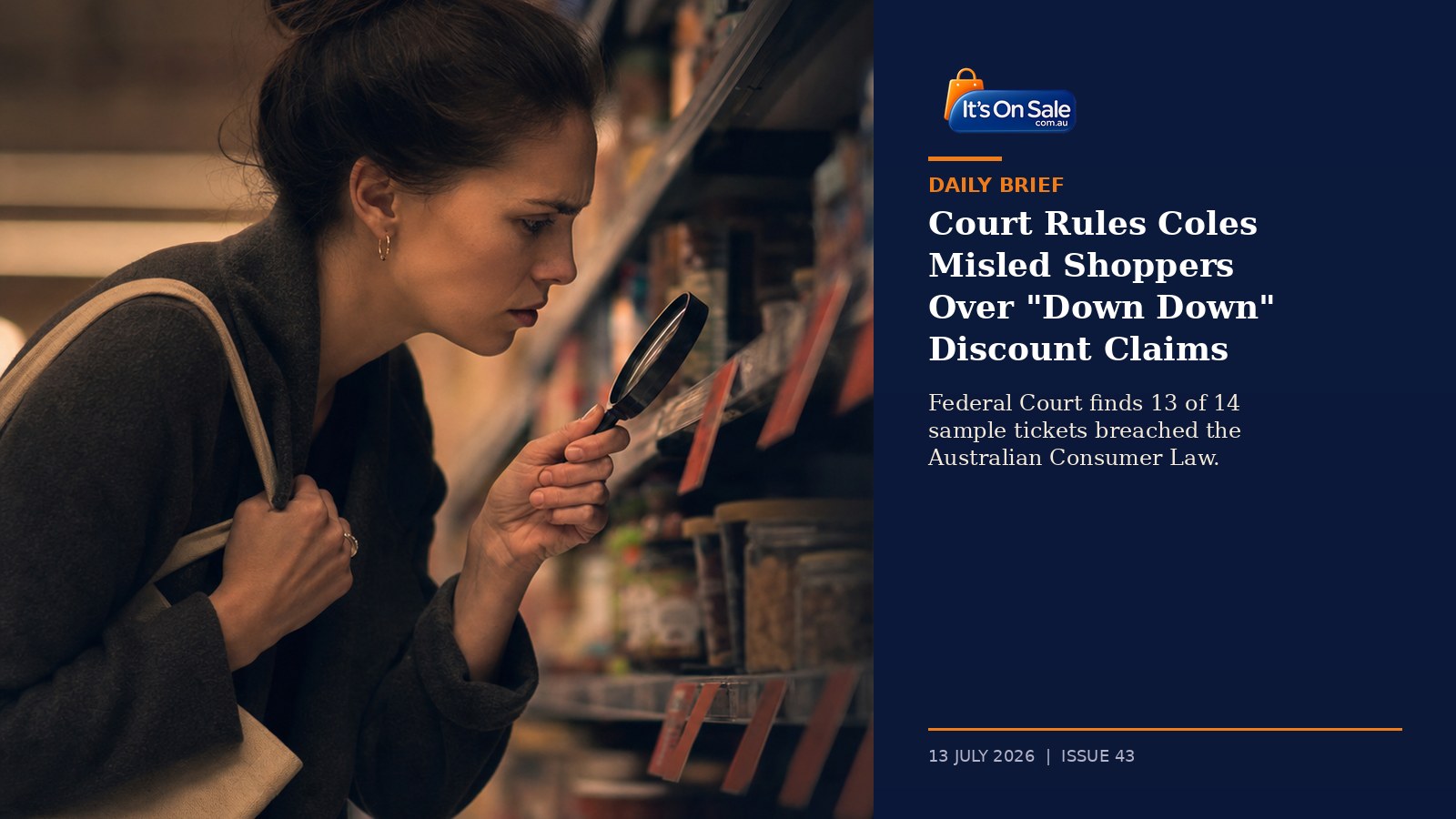

Monday morning and the Australian retail story has changed shape. The Federal Court has found that Coles Supermarkets misled shoppers in 13 of the 14 sample “Down Down” tickets tested by the Australian Competition and Consumer Commission, ruling the discounts illusory under sections 18 and 29 of the Australian Consumer Law. Justice Michael O’Bryan set a 12-week benchmark for a genuine “Was” price, drawing on Coles’ own internal pricing guardrails. Woolworths’ companion case is still to be decided, and Coles has said it is “reviewing the judgment,” with penalties potentially running into the hundreds of millions of dollars. Also in the frame: ASIC has now put a dollar figure on the four-year retail insolvency wave, and NBN wholesale prices lifted from 1 July, meaning most retail internet bills will move up this month. Five fresh Australian stores today, five categories, none carried over from the last three days.
Court Rules Coles Misled Shoppers Over “Down Down” Discount Claims
The Federal Court of Australia has handed down its decision in Australian Competition and Consumer Commission v Coles Supermarkets Australia Pty Ltd [2026] FCA 598, finding that Coles made false or misleading representations in 13 of the 14 sample “Down Down” tickets considered in the liability hearing (ACCC media release, 12 July 2026). The case, brought by the ACCC in 2024, covered 245 products where Coles temporarily increased prices by at least 15 per cent between February 2022 and May 2023, then placed them on “Down Down” promotions at prices equal to or higher than the shelf price before the temporary rise.
Justice Michael O’Bryan accepted that reasonable minds may differ on what counts as a “reasonable period” for a “Was” reference price, but concluded that 12 weeks is the appropriate benchmark for a genuine established price, drawing directly on Coles’ own internal pricing guardrails which, until March 2022, required a minimum 12-week price establishment period (Justin Malbon, Hall & Wilcox, 11 July 2026). In the sample, some products had only been sold at the “Was” price for as little as seven days before the “Down Down” discount was applied, and around four weeks in other cases. The single allegation that failed involved a Nature’s Gift dog food ticket, which did not display a specific “Was” price and therefore conveyed only a more general message that the price was promotional.
“We welcome the Court’s finding that Coles breached the Australian Consumer Law,” ACCC Chair Gina Cass-Gottlieb said in the statement released with the judgment. “The ACCC brought this case in the public interest because we considered that Coles’ pricing practices within its ‘Down Down’ program made it harder for customers to identify genuine value for money while shopping for household essentials.” Coles has said it is “reviewing the judgment” (SME Business Daily Media, 12 July 2026) and an appeal is still possible. The Court has given Coles and the ACCC until 29 May to agree on penalties and other orders, including a possible donation to Foodbank, before the matter returns for a penalty hearing. The maximum penalty under the Australian Consumer Law is $50 million per breach, three times the reasonably attributable benefit, or 30 per cent of adjusted turnover during the breach period, whichever is greater, and a separate class action brought by consumers against Coles will be dealt with alongside the penalty phase.
How To Read a “Down Down” or “Prices Dropped” Ticket From Now On
The practical read for Australian shoppers is the 12-week rule. When a supermarket “Down Down” ticket shows a “Was” price and a lower current price, the discount can only be treated as a genuine saving if the “Was” price was actually on the shelf for a reasonable period, and the Court has now set the benchmark at approximately 12 weeks. If the “Was” price appeared briefly (a week, a month) before the reduction was announced, the discount is likely engineered. The ACCC’s pricing guidance confirms that businesses must not make false or misleading claims about prices, including the reason for changes, and the Court’s finding makes that principle enforceable against ticket-level campaigns like “Down Down” and Woolworths’ “Prices Dropped.”
The consumer tools worth using are already in shoppers’ hands. Both Coles and Woolworths display in-app price histories on individual product pages, and independent trackers like OzBargain and Grocery Watch keep long records of shelf pricing that shoppers can cross-check. From 1 July 2026, new Food and Grocery Code rules also ban very large retailers (currently only Coles and Woolworths, both with more than $30 billion in annual Australian turnover) from engaging in excessive pricing, defined as pricing significantly above the cost of supply plus a reasonable margin (ACCC Food and Grocery Code). Importantly, under section 18 of the Australian Consumer Law, a finding of misleading conduct does not require proof that individual consumers suffered actual harm: it is enough that ordinary consumers were likely to form an incorrect impression. That lowers the bar for future enforcement.
ASIC Puts $3.66 Billion Figure On Retail’s Four-Year Insolvency Toll
ASIC Report 836, released this month, has for the first time attached a dollar figure to the wave of Australian retail administrations since 2021. Between 2021 and 2025, 238 retail voluntary administrations were recorded nationally, with total liabilities of $3.66 billion and median liabilities of $2.10 million per appointment (Aleks Cvetkovic, Ragtrader, 7 July 2026). Across the whole VA universe, 44 per cent of appointments resulted in an approved deed of company arrangement and 50 per cent ended in liquidation, with the DOCAs paying unsecured creditors an average of 21.3 cents in the dollar (median 11.5 cents). That figure is the practical read on what a store gift card is likely to be worth if the retailer holding it enters administration and then converts to a DOCA.
The report reinforces the pattern already visible in the Betts, Barbeques Galore, Lincraft, Glue Store and ZEN Energy Retail administrations tracked through June and early July. The lesson for Australian households remains the same. If you hold a gift card, store credit, layby balance or lifetime warranty against a public brand that is under visible commercial stress, treat the credit like cash that expires. Spend it inside the trading window, not later. Under the Corporations Act, gift cards and store credits held against a company in voluntary administration typically rank as unsecured claims, and ASIC’s numbers now confirm those claims recover closer to 20 cents in the dollar than to 100. The full ASIC Report 836 is publicly available on the ASIC insolvency statistics page.
NBN Wholesale Prices Rise From 1 July, Retail Bills To Follow
NBN Co adjusted its wholesale prices across all speed tiers on 1 July 2026, and the retail price rises are landing in customer inboxes across July (Steven Nixon, Canstar, 9 July 2026). The largest wholesale rise is on Home Hyperfast (NBN 1000/50) at $4.04 per month, followed by Home Superfast (NBN 250/25) at $3.19, Home Standard (NBN 50/20) at $2.34, and Home Fast (NBN 100/20) at $2.32. The Home Basic 12/1 wholesale price is the only one moving the other way, dropping one cent. Retail internet providers typically pass on more than the wholesale increase, so shoppers on Telstra, Optus and TPG plans should expect increases of between $3 and $6 per month across Home Standard and above.
The consumer move is not to accept the letter. When the notice arrives, use it as a switching trigger. On Home Fast (NBN 100/20) plans in July, Belong, Superloop, Aussie Broadband, Kogan Internet and Dodo consistently undercut the majors by $10 to $20 per month for equivalent speed. Aussie Broadband and Superloop in particular publish real-world CVC (capacity) figures, meaning the advertised speed is closer to the delivered speed than at the discount providers. If you have been on the same NBN plan for more than 12 months, the July rise is the cleanest moment of the year to switch. And a housekeeping note for October shoppers: the Visa, MasterCard and EFTPOS card-surcharge ban is still locked in for October 2026, which will remove the surcharge line item from most in-store and online checkouts nationally.
Five Fresh Australian Stores, Audited at Dawn
Five stores. Five categories. All fresh names today, none carried over from the last three days, all headline discounts verified from the live sale pages this morning.
Discount
 Cotton OnCasual FashionUp to 50 per cent off Cotton On sale: winter basics, denim, sweats, activewear and kids from the Geelong-headquartered Australian retailer, with Cotton On Perks and free delivery over $55.50%OFF2
 GlassonsWomen's Wear50 per cent off across Glassons: knits, denim, jackets and workwear from the Australian-owned womenswear label with local warehousing, click-and-collect and free returns.50%OFF3
 HallensteinsMen's WearUp to 50 per cent off Hallenstein Brothers: outerwear, knits, chinos and basics from the New Zealand and Australia menswear specialist, backed by local sizing and free returns.50%OFF4
 Healthy LifeHealth & BeautyUp to 50 per cent off Healthy Life: Australian-owned online health and pharmacy specialist covering vitamins, skincare, personal care and Australian-made supplements, with free shipping over $79.50%OFF5
 HouseHomewares50 per cent off House: kitchen, cookware, glassware and homewares from the Australian-owned specialist chain, plus HouseVIP rewards and Australia-wide delivery.50%OFF
% discounts shown are indicative across each store’s sale range. Individual product savings vary.
Other Deals Worth A Look
Beyond the Top 5, a handful of other Australian-owned retailers are running strong cuts through the Monday of the second full trading week of the new financial year. Macpac (today’s Top 6 ticker pick) has up to 50 per cent off winter jackets, thermals, packs and hiking layers from the New Zealand and Australia outdoor specialist. Kathmandu is running up to 50 per cent off winter jackets and packs. OPSM has up to 50 per cent off frames as part of the winter eyewear sale, with Medicare and health-fund claiming still available at checkout. Lounge Lovers has 50 per cent off across selected sofas and dining, with free Australian delivery on selected metros. Portmans is running up to 50 per cent off workwear and event dressing. All Australian-owned or locally fulfilled, all backed by Australian Consumer Law.
Our Take
The “Down Down” ruling matters because it changes what an ordinary Australian shopper is entitled to expect from a headline discount claim. For years, Coles and Woolworths trained the country to look for red tickets and to assume the “Was” price represented a stable, established shelf price. The Court has now said that assumption is legitimate, and that a “Was” price that has been on the shelf for a week, or a month, or even a quarter, is not a fair reference point. The 12-week benchmark is not an ACCC target; it is now a judicial standard. The lesson for shoppers is not that supermarket specials are worthless. It is that a supermarket discount is only meaningful when the “Was” price is genuinely established, and that is the read every red ticket should now get.
That is exactly why It’s On Sale exists. We track 35,000 Australian stores and 45,000 live sale products, every retailer Australian-owned or locally fulfilled, every promotion audited daily against the store’s own price history. Today’s Sales shows every store currently running a discount in one place. The AI search reads the way real shoppers ask (try “winter jackets under 100” or “womens work dresses”). None of it is Temu, Shein, AliExpress, Wish or any offshore marketplace dressed up as a local brand. Browse Today’s Sales on the Monday of the second full week of the new financial year, and make your money go further with Australian retailers who stand behind the ticket.