















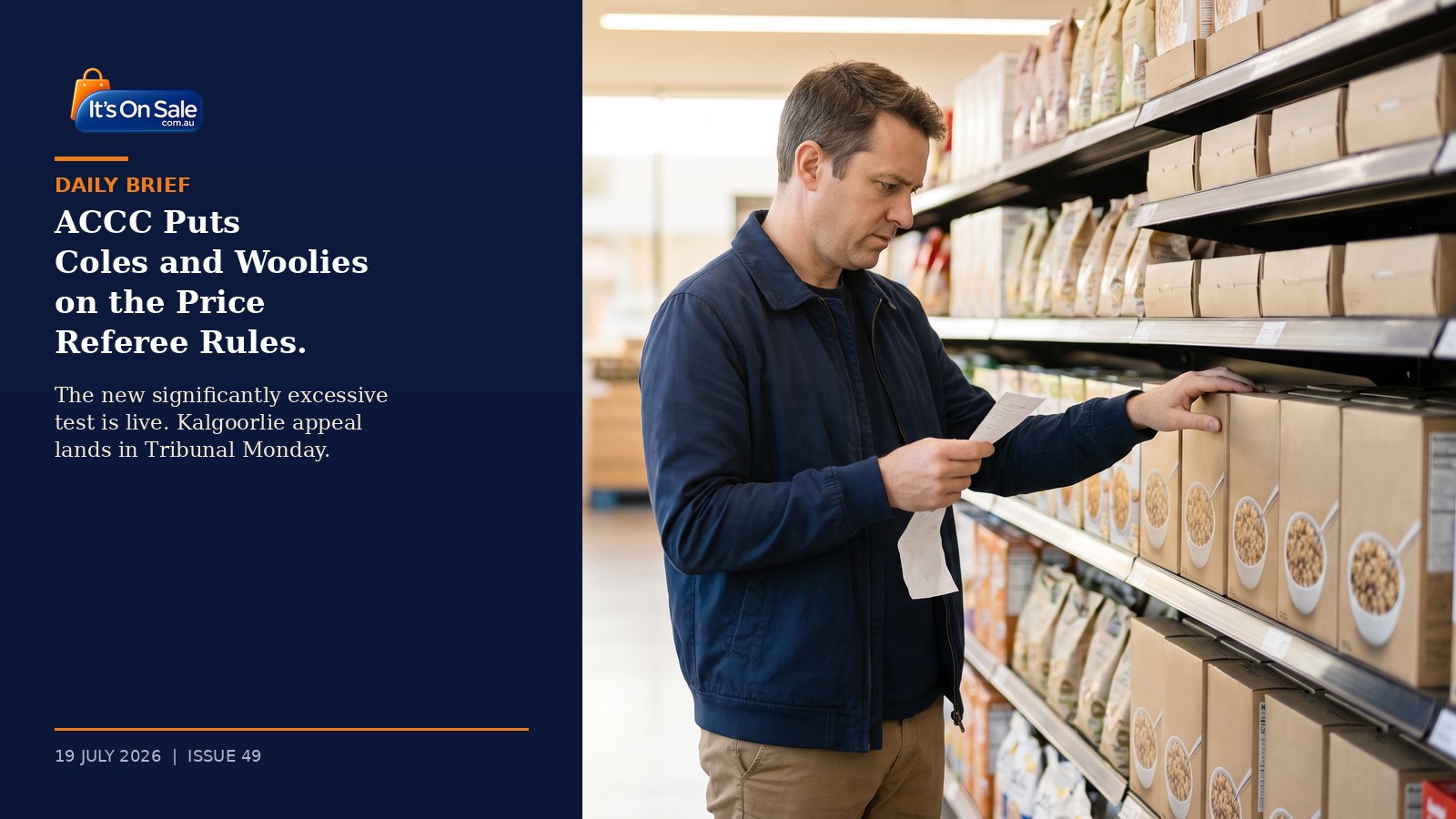

Sunday morning and the biggest shift in Australian retail this year is quietly clicking into place. From 1 July, the ACCC has new powers under the Competition and Consumer Act to police Coles and Woolworths for what the regulator calls significantly excessive grocery pricing, the first time in Australian retail history the pricing referee is on the field for the Big Two. This week the rulebook meets its first real-world test: Coles heads to the Australian Competition Tribunal on Monday 21 July to appeal the ACCC block on a second Kalgoorlie supermarket, a case with broader implications for every future supermarket development. In the household budget, fresh CommBank data confirms a widening age divide, over 65s spent 10.1 per cent more year on year while 18 to 24s cut spending growth almost in half. And Victoria Police is warning that EOFY tax-time scam sites are still live and multiplying, with the Cybercrime Squad already taking down 139 fake retail websites this month. Sunday’s Top 5 opens with Sportsgirl at up to 70 per cent off across the women’s range.
ACCC Puts Coles And Woolworths On The Price Referee Rules
Buried in a low-key update on the ACCC pricing page this week is the biggest structural change to Australian supermarket regulation since the 2020 Food and Grocery Code review: from Wednesday 1 July 2026, brand-new rules under the Competition and Consumer Act give the regulator explicit statutory powers to prevent excessive grocery pricing by supermarkets that earn more than $30 billion a year in Australia (referred to as very large retailers). The rules currently apply only to Coles and Woolworths, and the ACCC states plainly on its own site: “We are monitoring pricing by these supermarkets” (ACCC, Setting prices page, updated 15 July 2026). The legal test is described as significantly excessive when compared to the costs to the supermarket to supply the product plus a reasonable margin, a phrase that will be argued and re-argued in tribunals, before parliamentary inquiries and inside supermarket boardrooms for the rest of the decade.
The rules land in the same week the ACCC and Coles head into their first live courtroom test of the new merger regime. Coles has confirmed it will appeal, in the Australian Competition Tribunal, the ACCC decision to block a proposed second Coles supermarket and Liquorland site in the Western Australian mining town of Kalgoorlie, with a directions hearing listed for Monday 21 July 2026 (Tamika Seeto, Yahoo Finance Australia, 16 July 2026). A Coles spokesperson told Yahoo Finance the retailer “respectfully disagrees with the ACCC’s assessment and remains of the view that the proposed development would not substantially lessen competition in Kalgoorlie”, and warned the determination “may have broader implications for future supermarket developments under the new merger regime”. For shoppers the two levers now bear directly on the trolley: the regulator can question pricing conduct after the fact, and it can block or shape supermarket store rollouts before the fact.
Practical read for the household budget: nothing changes at Monday’s checkout, but the balance of power just shifted. If a supermarket weekly staple looks stubbornly high (think branded margarine, entry-level laundry powder, own-label dairy) shoppers now have a formal channel for scrutiny through the ACCC pricing feedback line, and a benchmark test that did not exist a fortnight ago. The Kalgoorlie hearing on Monday will not itself change any prices this week, but the Tribunal’s directions will set the timetable for a full merits review that could take months and will effectively define what significantly less competition means under the 1 January 2026 merger regime. Meanwhile the deepest weekend basket-check moves for households remain the classics: cross-check the Coles catalogue against Woolworths every Wednesday, use Aldi Special Buys for one-off pantry restocks, and lean on independent IGA plus co-op like Farmer Jack for meat and produce where the private-label pricing is often 15 to 25 per cent below Big Two shelf tags.
CommBank HSI Age Divide: Over 65s Spending 10.1 Per Cent More While Under 25s Cut Back
Fresh CommBank Household Spending Insights data released Thursday 16 July 2026 confirms the tightening cost-of-living squeeze is now landing very unevenly across age cohorts. Australians aged 65 and over recorded the strongest annual spending growth of any age group, up 10.1 per cent in the year to June 2026, while spending growth among 18 to 24 year olds nearly halved over the year from 9.9 per cent in June 2025 to 5.4 per cent in June 2026, the biggest slowdown of any age group (CommBank Newsroom, 16 July 2026). Growth among 25 to 34 year olds was the weakest at just 4.2 per cent, with 35 to 44 and 45 to 54 year olds close behind at 4.5 per cent each. CBA Head of Australian Economics Belinda Allen said “household consumption patterns diverge by age” and added that the mortgage-holding cohorts of 25 to 44 are “more likely to have a mortgage, making them more sensitive to higher interest rates”.
Buried in the detail is a striking exception that speaks directly to the tech-adopter shopper: spending on AI-related software and subscriptions has jumped more than 60 per cent over the past year, the fastest growth of any category CBA tracks. That is Perplexity, ChatGPT, Claude, GitHub Copilot, Midjourney, Notion AI and the growing raft of niche vertical AI tools now settling into monthly household budgets alongside Netflix and Spotify. On the other side of the ledger, service-station spending fell 6.7 per cent in June alone, insurance is up 8.3 per cent for the year, utilities up 10.7 per cent for the year, and electricity and gas costs up roughly 18 per cent. For under 35 shoppers the practical playbook is the substitution ladder: switch to Coles Own Brand and Woolworths Homebrand across staple pantry (typical 20 to 35 per cent unit-price cut), take up the free Everyday Rewards or Flybuys card if you have not already (real weekly value averages $6 to $12 per household), and cross-shop Aldi Special Buys weekly for one-off appliance and homewares purchases where the private-label price gap is widest.
Victoria Police Warns EOFY Scam Sites Are Still Live, 139 Fake Retailers Taken Down
Victoria Police, together with the state Cybercrime Squad, issued a fresh warning on Friday 17 July 2026 that scam sites impersonating well-known Australian retailers are still live and multiplying two weeks after the peak EOFY sales window closed. The squad has already issued takedown requests for 139 fake online store related websites this month, and detectives said scammers are now combining the tax-time myGov push with fake retailer fronts because shoppers are more likely to click through email lures during the July tax-refund window (Star Community News, 17 July 2026). Detectives note that scam sites usually mimic the brand’s logo, layout and product imagery, often include a .com.au domain, and sometimes even display the stolen ABN of the genuine business. They also commonly pay for sponsored ads at the top of search results, or offer the same product at a significantly lower price than the genuine store.
Simple shopper-side defence for the week ahead: never click a link in an email or SMS claiming to be from the ATO, myGov or a retailer, always type the retailer domain directly or use a verified bookmark, and treat any deal that looks too good (a Dyson at 60 per cent off, an iPhone at half price, a designer bag at a fifth of the RRP) as a scam until proven otherwise. Cross-check the retailer via the Australian Business Register at abr.business.gov.au (real businesses show a matching ABN plus registered trading name), and if in doubt, browse the store from the platform where you already trust the listing rather than following an inbound link. Report suspicious retail sites straight to scamwatch.gov.au/report-a-scam, and any suspected ATO or myGov impersonation to [email protected]. If a payment has already gone through, call your bank or card provider immediately (most transactions can be stopped inside two hours). This one costs nothing to get right and is the single highest-return five-minute habit any online shopper can build in 2026.
The Week Ahead: What Australian Shoppers Should Track
Four dates matter for Australian shopper wallets between now and mid-August, and three of them cluster inside the next three weeks. Monday 21 July: Coles Kalgoorlie appeal, first directions hearing in the Australian Competition Tribunal, no immediate pricing impact but sets the pace for the first full ACCC merger test of 2026. Wednesday 29 July at 11:30am AEST: the Australian Bureau of Statistics releases the June quarter Consumer Price Index alongside the very first monthly headline CPI print for June, a double release that will fix the RBA’s inflation reading for the August rate meeting. Sunday 2 August at 11:59pm: the temporary fuel excise cut fully unwinds, with full excise of 52.8 cents per litre resuming from Monday 3 August (average pump prices are expected to rise roughly 10 to 12 cents per litre through the following week). Tuesday 12 August: the RBA cash-rate decision at 2:30pm AEST, with the market currently split roughly 60/40 on a hold versus a 0.25 percentage point cut.
Household planning moves this week: fill the tank on Saturday 1 August before the full excise resumes, front-load any planned discretionary purchase (winter jacket, mattress, small appliance) before the 12 August rate meeting because a rate hold plus a hot CPI print would push retailer discounting deeper into September, and check the David Jones and Myer mid-year sale windows which close around the first weekend of August. For anyone considering a mortgage refinance, the two weeks between the 29 July CPI print and the 12 August RBA meeting is historically the flattest quote window of the calendar as lenders wait for the RBA before repricing, meaning quotes locked this week are unlikely to be improved on before mid-August. For shoppers with an eye on the ACCC pricing regime, the Coles Kalgoorlie hearing tomorrow will not itself move prices but is the first live indicator of how aggressively the ACCC intends to use its new powers, and every retailer, wholesaler and shopper in Australia will be watching the tribunal transcript.
Five Fresh Australian Stores, Audited At Dawn
Five stores. Five categories. All fresh names today, none carried over from the last three days, all headline discounts verified from the live sale pages this morning.
Discount
 SportsgirlWomen's WearUp to 70 per cent off Sportsgirl: dresses, denim, knitwear, coats and going-out styles from the Melbourne-founded Australian womenswear label owned by Sussan Group, with Afterpay, Zip and free shipping over $100.70%OFF2
 HouseHomewaresUp to 50 per cent off House: cookware, glassware, storage, homewares and small kitchen appliances from the Global Retail Brands Australian-owned chain, with Afterpay, Zip and click-and-collect at over 160 stores nationwide.50%OFF3
 MacpacOutdoor & CampingUp to 50 per cent off Macpac: hiking jackets, thermals, packs, sleeping bags and camping gear from the trans-Tasman outdoor brand with strong Australian retail presence and a lifetime repair guarantee on packs.50%OFF4
 Nine WestFootwearUp to 50 per cent off Nine West: heels, boots, sneakers, flats and handbags from the American women’s footwear label with an Australian-run retail presence, Afterpay, Zip and free shipping over $100.50%OFF5
 OPSMOpticalUp to 50 per cent off OPSM: prescription glasses, sunglasses, contact lenses and premium brand eyewear from the Australian-founded optical retailer owned by EssilorLuxottica, with Medicare and health-fund claims processed in store.50%OFF
% discounts shown are indicative across each store’s sale range. Individual product savings vary.
Other Deals Worth A Look
Beyond the Top 5, a handful of other Australian-owned or locally fulfilled retailers are worth a Sunday scroll on the last weekend before the excise unwind and the CPI print. Typo (today’s Top 6 ticker pick) has up to 50 per cent off stationery, gifts, homewares, tech accessories and travel goods from the Geelong-founded Cotton On Group brand, with Afterpay, Zip and free shipping over $55. Koala keeps clearance pricing on mattresses, sofas, bunk beds and bedding from the Australian-owned certified B Corp with 120-night trials and free delivery. David Jones continues the winter mid-year runout across menswear, womenswear, homewares and beauty from the Melbourne and Sydney flagship department store, with free shipping over $100. Temple & Webster has running winter prices on lounge, dining, outdoor and rugs from the Australian-listed online furniture specialist, with free returns on most items and click-to-order Australia-wide. JB Hi-Fi continues its This Week’s Hottest Deals across TVs, laptops, headphones and kitchen appliances from the Australian-listed electronics retailer, with in-store price beat and click-and-collect at over 200 locations. Chemist Warehouse is running the weekly half-price specials on vitamins, supplements, skincare and personal care from the Australian-owned discount pharmacy, with Sundays a typically strong replenishment day. All Australian-owned or locally fulfilled, all backed by the Australian Consumer Law.
Our Take
Sunday 19 July marks a genuine structural shift in Australian retail: for the first time, the ACCC can question Coles and Woolworths on any grocery price under a formal statutory test, and the same regulator can block a supermarket rollout before a spade goes in the ground. Together they represent the biggest expansion of consumer-facing supermarket regulation in a generation. That does not mean prices tumble tomorrow. What it does mean is that the two retailers who together control roughly 65 per cent of Australian grocery spend now operate under a real referee, and every future price rise, every future store approval, every future acquisition target has a formal shopper-side test attached to it. The CommBank data alongside this tells the other half of the story: households, particularly younger ones, are running out of room to absorb further price rises, and the retailers who thrive over the next twelve months will be the ones who read that number honestly, discount deeply and transparently on live inventory, and stop treating shoppers as if the 2021 to 2022 cost-of-living squeeze never happened.
That is exactly why It’s On Sale exists. We track 35,000 Australian stores and 45,000 live sale products, every retailer Australian-owned or locally fulfilled, every promotion audited daily against the store’s own price history. No trial traps, no hidden fees, no offshore marketplaces dressed up as a local brand. Today’s Sales shows every store currently running a discount in one place. The AI search reads the way real shoppers ask (try “womens winter knitwear under 100” or “kids school shoes half price”). None of it is Temu, Shein, AliExpress, Wish or any offshore marketplace dressed up as a local brand. Browse Today’s Sales on Sunday morning ahead of a week that will genuinely reshape the balance of power between shoppers and the Big Two, and make your money go further with Australian retailers who stand behind the ticket.