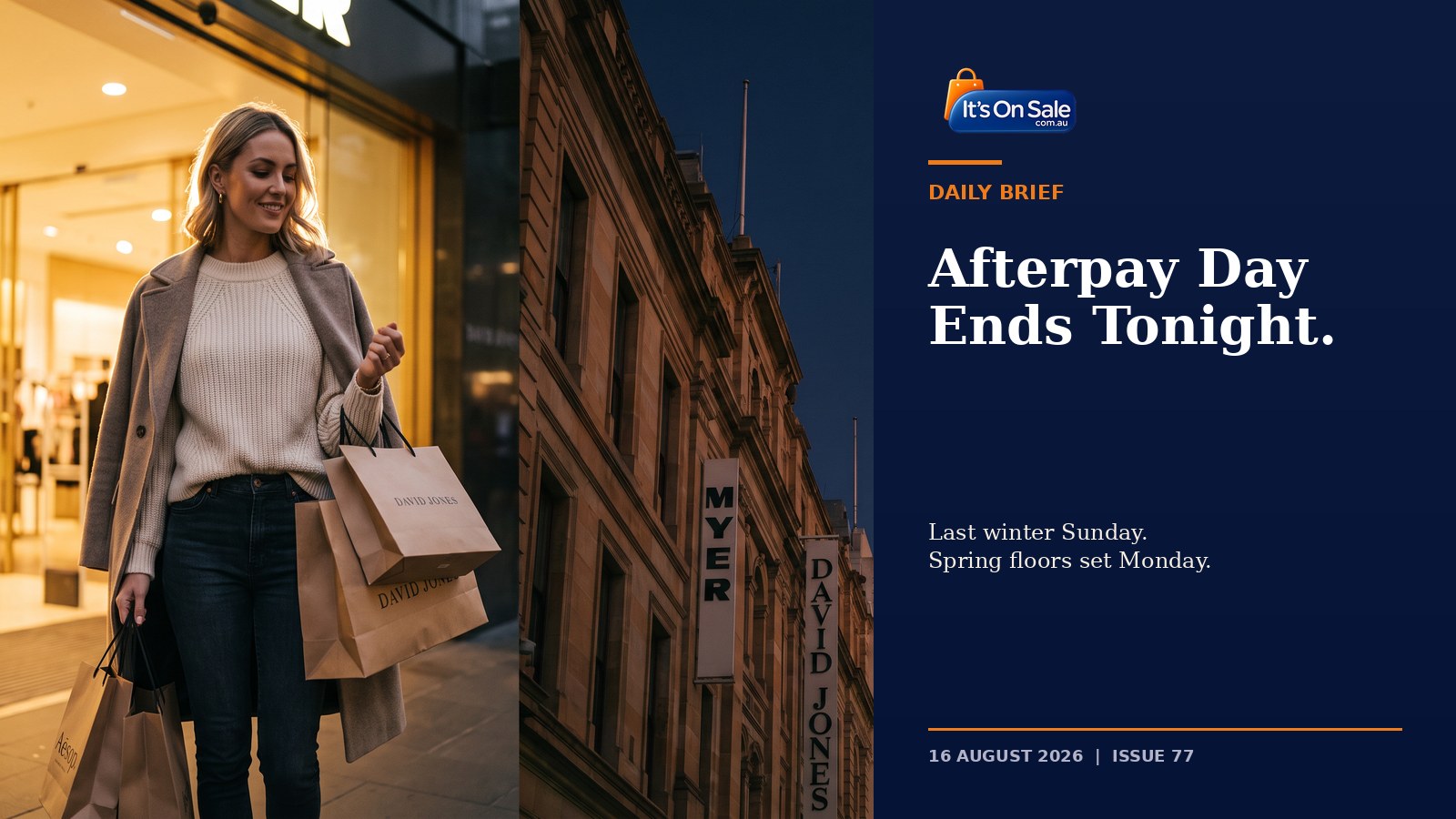
















Editorial hero, an Australian shopper in her thirties reading a shelf-edge price ticket in a supermarket aisle at afternoon light with a soft-focus 30 per cent off sign in the background, illustrating new excessive pricing rules that came into force on 1 July 2026 under the Food and Grocery Code of Conduct

Grocery Discounts Face New Excessive Pricing Limits. Coles Kalgoorlie Tribunal Directions Today. EOFY Sales Failed To Move The Needle. | It s On Sale Daily Brief, 21 July 2026

Tuesday morning and the ground rules of the Australian supermarket aisle have quietly changed: since 1 July 2026 it has been illegal for Coles and Woolworths to charge prices that are significantly excessive compared to their own cost of supply plus a reasonable margin, with maximum penalties of $10 million per breach. Today, Coles walks into the Australian Competition Tribunal for the case management hearing on its appeal against the ACCC block on a second Kalgoorlie supermarket, the first live test of the new merger regime effective 1 January 2026. Fresh CommBank and NAB data confirm what most household budgets already knew: EOFY sales failed to move the needle in June, with recreation spending decelerating from 2.3 per cent growth in May to 0.2 per cent. Tuesday’s Top 5 opens with Princess Polly at up to 80 per cent off.

Grocery Discounts Now Have To Be Economically Justified

Under the new excessive pricing provisions of the Food and Grocery Code of Conduct, which took effect on 1 July 2026, it is now illegal for a very large supermarket (defined as one with annual revenue above $30 billion, which currently means only Coles and Woolworths) to charge prices that are significantly excessive when compared to the cost of supplying the product plus a reasonable margin (Australian Associated Press coverage via news.com.au, 20 July 2026). The rules were legislated in response to two years of consumer outrage over grocery prices, the ACCC 2024-2025 supermarket inquiry, and repeated Senate hearings during 2025 where both major chains defended their margins under sustained questioning.

Cost of supply, as defined in the new provisions, can include what the supermarket pays to buy or produce the item, transport and logistics, staff wages, store rent, research and development, and investment in equipment or technology. The reasonable margin is not fixed at a single percentage, it depends on what is reasonable in the circumstances of the individual product, and it will be tested case by case if a breach is alleged. Maximum penalties sit at $10 million per breach, or three times the benefit obtained, or 10 per cent of annual turnover in Australia, whichever is greatest. Only the ACCC can bring a proceeding under the code; consumers cannot sue directly, which is a point the government has flagged to review after the first twelve months.

Practical shopper read: at Coles and Woolworths, expect the era of the mystery 50 per cent off ticket on a $2 tin of tomatoes to be quietly retired. Discounts will still exist, they will still be aggressive on genuinely overstocked or short-dated stock, but the eye-watering percentage claims that were partly a product of an inflated pre-discount ticket price are now legally risky. If you have watched a product cycle between $6 full price, $3 half price, $6 full price for eighteen months, that pattern is exactly what the new rules were written to end. It also means that outside the Big Two, the smaller Australian-owned grocers, IGA operators, ALDI (below the $30 billion threshold), and specialist food retailers now have a cleaner playing field on which to compete on genuine value. Shoppers who track live prices with tools like the ACCC MyGrocery pilot, the state government Food Prices Reporter apps and independent trackers like Today’s Sales are best positioned to spot which chains are pricing sharpest on the items they actually buy each week.

Coles Kalgoorlie Appeal Hits The Tribunal Today

The Australian Competition Tribunal holds the first case management hearing today, Tuesday 21 July 2026, in Coles Group’s appeal against the ACCC decision to block its proposed second Coles supermarket and Liquorland outlet in Kalgoorlie (Sean Cao, Inside FMCG, 17 July 2026). The 2,800 square metre site at Lots 95-106 Great Eastern Highway in the Somerville area of Kalgoorlie is the first supermarket application the ACCC has outright refused under the new merger regime that took effect on 1 January 2026, which requires supermarkets to notify the ACCC of any acquisition of a commercial site over 1,000 square metres or a vacant land site over 2,000 square metres. In blocking the deal, the ACCC found the second Coles would substantially lessen competition in the Kalgoorlie market, currently served by an existing Coles, a Woolworths, an IGA and independent operators.

Cat Fredenburgh, filing for legal industry publication Lawyerly on Thursday 16 July, reported Coles argued in its Tribunal application that the ACCC finding “was not objectively correct” and that the acquisition would not substantially lessen competition in the local market (Cat Fredenburgh, Lawyerly, 16 July 2026). A Coles spokesperson told the Australian Financial Review that the company “respectfully disagrees with the ACCC’s assessment” and warned the decision “may have broader implications for future supermarket developments under the new merger regime” (AFR, 16 July 2026). Bird & Bird analysts note the appeal is effectively a stress test of how the Tribunal will interpret the ACCC’s new merger powers in geographically remote markets where the incumbents already hold most of the shelf space (Bird & Bird analysis, July 2026).

Practical shopper read: today’s directions hearing will not shift a single price at any checkout in Australia, it will set the timetable, evidence framework and hearing dates for the full merits review, which is expected to run for several months. Combined with the new excessive pricing rules that started 1 July, the Tribunal outcome will define both the price ceiling (through code enforcement) and the store rollout ceiling (through merger review) for every supermarket group in Australia. For Kalgoorlie shoppers today, the existing Coles, Woolworths and IGA options continue as normal, catalogues out Wednesday, weekly specials refreshed midnight Tuesday.

EOFY Sales Failed To Move The Needle In June

The CommBank Household Spending Insights index for June 2026, released on Wednesday 16 July, showed household spending rose just 0.3 per cent for the month, one of the softest reads since the pandemic-era stimulus wound down (CommBank Newsroom, 16 July 2026). Retail spending eased to 0.2 per cent in June from 0.6 per cent in May despite the End of Financial Year sale cycle, and recreation spending decelerated sharply from 2.3 per cent growth in May to just 0.2 per cent in June. Utilities (up 1.4 per cent) and Education (up 1.1 per cent) led the categories that did grow, both driven by seasonal timing rather than genuine discretionary spend. The NAB Consumer Spend Trend for June, released on Tuesday 15 July, showed total spending up 1.2 per cent for the month and 6.8 per cent for the year, but the growth was concentrated in discretionary rather than non-discretionary categories, indicating households are still willing to buy the coffee and the concert ticket but stretching hard on the grocery basket (NAB Business Research, 14 July 2026).

Cameron Micallef at The Nightly, filing his story on Thursday 16 July, put the pattern more directly: EOFY sales did not spark the usual spending spree, with retail data pointing to weakness across furniture, electronics and household goods despite widespread advertised discounting (Cameron Micallef, The Nightly, 16 July 2026). Age cohort data shows the split clearly: spending growth was strongest among those aged 65 and over (up 10.1 per cent year-on-year), while 18 to 24 year olds slowed hardest, from 9.9 per cent annual growth in 2025 to just 5.4 per cent in the twelve months to June 2026. Regional Queensland and regional Western Australia were the strongest performers by geography over the year, while metro NSW, the ACT and metro Victoria were the weakest.

Practical shopper read: the data confirms what most under-35 households already know from lived experience: EOFY sales were not the discount reset they used to be. That does not mean genuine deals do not exist right now, it means the average headline discount is doing less real work than it did in 2024, and shoppers who compare live prices against 90-day price histories will do best. For the second half of the year, the Australian Retailers Association is already forecasting a slower ramp into Father’s Day (7 September), the October retail cycle, and Black Friday than the same period in 2025, unless the RBA cuts rates on 12 August (which the market is currently pricing at roughly 40 per cent probability).

Tuesday’s Top 5 Deals

Every store in Tuesday’s Top 5 is Australian-owned or locally fulfilled. Every discount was checked against the store’s current sale page before publication. None of it is Temu, Shein, AliExpress, Wish or any offshore marketplace dressed up as a local brand. Every product ships from an Australian warehouse and is backed by the Australian Consumer Law.

Other Deals Worth A Look

Beyond the Top 5, a handful of other Australian-owned or locally fulfilled retailers are worth a Tuesday scroll on the second full week before the excise unwind and the CPI print. General Pants (today’s Top 6 ticker pick) has up to 50 per cent off jeans, denim, sneakers, streetwear and outerwear from the Australian-owned youth fashion retailer with over 60 stores nationwide, with Afterpay, Zip and free shipping over $50. Koala keeps clearance pricing on mattresses, sofas, bunk beds and bedding from the Australian-owned certified B Corp with 120-night trials and free delivery. David Jones continues the winter mid-year runout across menswear, womenswear, homewares and beauty from the Melbourne and Sydney flagship department store, with free shipping over $100. Temple & Webster has running winter prices on lounge, dining, outdoor and rugs from the Australian-listed online furniture specialist, with free returns on most items and click-to-order Australia-wide. JB Hi-Fi continues its This Week’s Hottest Deals across TVs, laptops, headphones and kitchen appliances from the Australian-listed electronics retailer, with in-store price beat and click-and-collect at over 200 locations. Chemist Warehouse is running the weekly half-price specials on vitamins, supplements, skincare and personal care from the Australian-owned discount pharmacy. All Australian-owned or locally fulfilled, all backed by the Australian Consumer Law.

Week Ahead

Four dates matter for Australian shopper wallets between today and mid-August. Today, Tuesday 21 July: Coles Kalgoorlie appeal, first case management hearing in the Australian Competition Tribunal, no immediate pricing impact but sets the tempo for the first full ACCC merger test of 2026 alongside the new excessive pricing rules that started 1 July. Wednesday 29 July at 11:30am AEST: the Australian Bureau of Statistics releases the June quarter Consumer Price Index alongside the very first monthly headline CPI print for June, a double release that will fix the RBA’s inflation reading for the August rate meeting. Sunday 2 August at 11:59pm: the temporary fuel excise cut fully unwinds, with full excise of 52.8 cents per litre resuming from Monday 3 August (average pump prices are expected to rise roughly 10 to 12 cents per litre through the following week). Tuesday 12 August: the RBA cash-rate decision at 2:30pm AEST, with the market currently split roughly 60/40 on a hold versus a 0.25 percentage point cut.

Our Take

Tuesday 21 July marks the first day of a genuinely new pricing regime in Australian supermarkets: for the first time, an economic justification test now sits behind every promotional ticket at Coles and Woolworths, and today the same two brands face their first live merger appeal under rules that took effect just seven months ago. The 1 July excessive pricing rules and the 1 January merger regime, taken together, are the most significant remaking of Australian supermarket regulation in a generation. And the June CommBank and NAB spending data confirm the demand-side truth that made the regulation politically inevitable: shoppers, especially households under 35, have essentially run out of room to absorb further real price rises, and headline EOFY discounts are no longer doing their historical job of clearing overhang stock and pulling in new spending. The retailers who thrive over the next twelve months will be the ones who read that number honestly, discount deeply and transparently on live inventory, and treat their pricing pages as a legally defensible economic document, not a marketing sandbox.

That is exactly why It’s On Sale exists. We track 35,000 Australian stores and 45,000 live sale products, every retailer Australian-owned or locally fulfilled, every promotion audited daily against the store’s own price history. No trial traps, no hidden fees, no offshore marketplaces dressed up as a local brand. Today’s Sales shows every store currently running a discount in one place. The AI search reads the way real shoppers ask (try “womens winter knitwear under 100” or “kids school shoes half price”). None of it is Temu, Shein, AliExpress, Wish or any offshore marketplace dressed up as a local brand. Browse Today’s Sales on Tuesday morning ahead of a week that will genuinely reshape the balance of power between shoppers, workers, and the Big Two, and make your money go further with Australian retailers who stand behind the ticket.

Editorial hero, a supermarket worker in a navy uniform tidying tinned goods on the shelves of a quiet dawn-lit aisle, illustrating the Aldi $55 million underpayment settlement with 32,000 store and warehouse workers

Aldi To Pay $55 Million To 32,000 Workers. Coles Kalgoorlie Tribunal Hearing Tomorrow. Brisbane Fuel Cycle Back. | It s On Sale Daily Brief, 20 July 2026

Monday morning and one of the largest Australian retail-worker settlements on record has been reached: Aldi has agreed to pay approximately $55 million to about 32,000 current and former store and warehouse employees to settle a Federal Court class action over unpaid pre-shift and post-shift work, subject to court approval. On Tuesday tomorrow, Coles walks into the Australian Competition Tribunal for a case management hearing on its appeal against the ACCC block on a second Kalgoorlie supermarket, the first live test of the new supermarket merger regime effective 1 January 2026. Congo Brands has begun winding up the Australian arm of influencer sensation Prime Hydration. And RACQ is warning that the Brisbane fuel cycle is quietly returning, right before the full fuel excise resumes on Monday 3 August. Monday’s Top 5 opens with Showpo at up to 80 per cent off.

Aldi To Pay $55 Million To 32,000 Workers In Class-Action Settlement

The Shop, Distributive and Allied Employees Association (SDA) announced on Wednesday 16 July 2026 that a proposed settlement had been reached with Aldi Stores (A Limited Partnership) in the Federal Court class action alleging widespread underpayment for work performed before rostered shifts began, and for store staff, after rostered shifts finished (SDA media release, 16 July 2026). The settlement covers approximately 32,000 current and former Aldi store employees, store managers, assistant store managers, and warehouse employees across Australia, and is one of the largest retail-worker underpayment settlements in Australian history. Aldi has already paid approximately $28.9 million of the total, with a further $26.3 million payable plus interest, and a separate $1.5 million contribution towards SDA legal and project costs. Critically for workers, no legal costs or litigation-funding commission will be deducted from settlement payments, meaning workers keep the full amount owed.

Cindy Cameronne at Lawyerly, filing the story at 3:11pm Sydney time on 16 July, reported the case had been running since 2022 with detailed allegations that Aldi store and warehouse rostering systems required staff to arrive early to prepare tills, unpack pallets or set up the sales floor, and (for store staff) stay late to complete cash-up and close-down tasks, all without paid recognition (Cindy Cameronne, Lawyerly, 16 July 2026). The Australian Financial Review confirmed the settlement value in a Wednesday 15 July report noting Aldi had also paid the SDA $1.5 million towards costs (AFR, 15 July 2026). Federal Court final approval is still required, and formal registration for eligible former employees will only open after that approval. For the more than 30,000 current Aldi workers already in the store or warehouse system, no immediate action is required, back-payments will flow through the settlement mechanism once approved.

Consumer-side read: Aldi has built its Australian market position on private-label pricing that runs roughly 15 to 25 per cent below equivalent Coles and Woolworths shelf tags, and part of that gap has always come from tight labour scheduling. A $55 million bill (about $1,700 per worker averaged out, though individual payments will vary sharply by tenure and hours) is a live reminder that low-price retail is not free, and that shoppers who value the Aldi trolley economics are also indirectly buying into a labour model that has now been formally litigated. Nothing changes at the checkout on Monday, Special Buys still land Wednesday and Saturday, the Sunday roast cut is still under $10 a kilogram, and the private-label chocolate is still half the Cadbury RRP. What has changed is that the ledger just got settled, publicly, and every large retailer in Australia will be reading the fine print of this settlement over the next fortnight.

Coles Kalgoorlie ACCC Appeal Hits The Tribunal Tomorrow

Coles will front the Australian Competition Tribunal on Tuesday 21 July 2026 for the case management hearing in its appeal against the ACCC decision to block a proposed second Coles supermarket and Liquorland outlet in the Western Australian gold-mining city of Kalgoorlie (Sean Cao, Inside FMCG, 17 July 2026). The 2,800 square metre site at Lots 95-106 Great Eastern Highway in Somerville, Kalgoorlie, is the first supermarket application the ACCC has outright refused under the new merger regime that took effect on 1 January 2026, which requires supermarkets to notify the ACCC of any acquisition of a commercial site over 1,000 square metres or a vacant land site over 2,000 square metres. In blocking the deal, the ACCC said the second Coles would substantially lessen competition in the local Kalgoorlie market, currently served by an existing Coles, a Woolworths, an IGA, and independent operators.

A Coles spokesperson said the retailer “respectfully disagrees with the ACCC’s assessment and remains of the view that the proposed development would not substantially lessen competition in Kalgoorlie”, and warned that the decision “may have broader implications for future supermarket developments under the new merger regime” (AFR, 16 July 2026). Bird & Bird analysts noted that the appeal is effectively a stress test of how the tribunal will interpret “substantially lessen competition” in geographically remote markets where the incumbents already hold most of the shelf space (Bird & Bird analysis, July 2026). Tuesday’s directions hearing will not resolve the substantive appeal, it will set the timetable, evidence framework and hearing dates for the full merits review, which is expected to run for several months.

Practical shopper read: tomorrow’s hearing will not shift a single price at any checkout in Australia, but the framework the tribunal lays down over the next three months will define how aggressively the ACCC can use its new merger powers to shape supermarket rollouts nationwide. If Coles wins, the ACCC will be far more cautious about outright blocks and shift towards behavioural undertakings; if Coles loses, expect much slower supermarket approvals across regional Australia and a more assertive ACCC on every large-format grocery, hardware and department-store proposal from Karratha to Cairns. For Kalgoorlie shoppers today, the existing Coles, Woolworths and IGA options continue as normal, catalogues out Wednesday, weekly specials refreshed midnight Tuesday.

Prime Hydration Collapses And RACQ Warns Brisbane Fuel Cycle Is Back

Congo Brands, the American owner of Prime Hydration, moved on 7 July 2026 to wind up the Australian arm of the influencer-driven sports-drink phenomenon, with administrator Alice Ruhe of BRI Ferrier reporting the Melbourne-based business had lost $1.42 million in 2024 and owed approximately $7.92 million to suppliers at the point of collapse (Harry Booth, Inside FMCG, 13 July 2026). The first meeting of creditors was held on Friday 17 July. Prime was famously co-founded by Logan Paul and KSI, launched globally in 2022 and hit peak resale prices of US$1,500 for a single 500ml bottle during the UK supermarket frenzy of 2023, before Australian supermarket distribution normalised prices back to $4 a bottle by late 2024. Shoppers with unopened Prime bottles in the pantry face no immediate risk (product is safe, best-before dates remain valid), but retailers holding stock now become the loss-bearers rather than Congo Brands Australia.

Meanwhile RACQ economic and affordability expert Ian Jeffreys warned on Monday 14 July that the Brisbane fuel cycle is quietly returning, with average unleaded at 172.1 cents per litre and roughly 10 per cent of Brisbane service stations already near $2 per litre at the top of the cycle (ABC News, 14 July 2026). Jeffreys said: “We believe this indicates that fuel companies are beginning to reestablish a price cycle.” The timing matters, the temporary fuel excise cut was halved on 1 July, and the remaining half unwinds fully on Monday 3 August 2026, adding roughly 32 cents per litre back to pump prices. Combined household planning move for the week: fill the tank at a bottom-of-cycle station this coming weekend (Sunday 26 July is historically the deepest trough), and use apps such as PetrolSpy, MotorMouth or 7-Eleven Fuel Lock to pin the sub-170 price before the 3 August reset.

The Week Ahead: What Australian Shoppers Should Track

Four dates matter for Australian shopper wallets between now and mid-August. Tuesday 21 July: Coles Kalgoorlie appeal, first case management hearing in the Australian Competition Tribunal, no immediate pricing impact but sets the tempo for the first full ACCC merger test of 2026. Wednesday 29 July at 11:30am AEST: the Australian Bureau of Statistics releases the June quarter Consumer Price Index alongside the very first monthly headline CPI print for June, a double release that will fix the RBA’s inflation reading for the August rate meeting. Sunday 2 August at 11:59pm: the temporary fuel excise cut fully unwinds, with full excise of 52.8 cents per litre resuming from Monday 3 August (average pump prices are expected to rise roughly 10 to 12 cents per litre through the following week). Tuesday 12 August: the RBA cash-rate decision at 2:30pm AEST, with the market currently split roughly 60/40 on a hold versus a 0.25 percentage point cut.

Household planning moves this week: fill the tank on Saturday 1 August before the full excise resumes, front-load any planned discretionary purchase (winter jacket, mattress, small appliance) before the 12 August rate meeting because a rate hold plus a hot CPI print would push retailer discounting deeper into September, and check the David Jones and Myer mid-year sale windows which close around the first weekend of August. The Westpac-Melbourne Institute Consumer Sentiment index lifted 4.1 per cent to 83.9 in July, its best reading in three months, but still sits inside the bottom 10 per cent of the 50-year survey history (Morningstar, 14 July 2026). For anyone considering a mortgage refinance, the two-week window between the 29 July CPI print and the 12 August RBA meeting is historically the flattest quote window of the calendar, meaning quotes locked this week are unlikely to be improved on before mid-August.

Top 5 Deals of the Day

Five Fresh Australian Stores, Audited At Dawn

Five stores. Five categories. All fresh names today, none carried over from the last three days, all headline discounts verified from the live sale pages this morning.

% discounts shown are indicative across each store’s sale range. Individual product savings vary.

Other Deals Worth A Look

Beyond the Top 5, a handful of other Australian-owned or locally fulfilled retailers are worth a Monday scroll on the last full week before the excise unwind and the CPI print. UGG (today’s Top 6 ticker pick) has up to 30 per cent off ugg boots, slippers, moccasins and sheepskin accessories from the original Australian-owned UGG family business, made in Australia from Australian sheepskin, with Afterpay, Zip and free Australian shipping over $99. Koala keeps clearance pricing on mattresses, sofas, bunk beds and bedding from the Australian-owned certified B Corp with 120-night trials and free delivery. David Jones continues the winter mid-year runout across menswear, womenswear, homewares and beauty from the Melbourne and Sydney flagship department store, with free shipping over $100. Temple & Webster has running winter prices on lounge, dining, outdoor and rugs from the Australian-listed online furniture specialist, with free returns on most items and click-to-order Australia-wide. JB Hi-Fi continues its This Week’s Hottest Deals across TVs, laptops, headphones and kitchen appliances from the Australian-listed electronics retailer, with in-store price beat and click-and-collect at over 200 locations. Chemist Warehouse is running the weekly half-price specials on vitamins, supplements, skincare and personal care from the Australian-owned discount pharmacy. All Australian-owned or locally fulfilled, all backed by the Australian Consumer Law.

Our Take

Monday 20 July marks a moment that will show up in Australian retail textbooks: the biggest single retail-worker underpayment settlement in the country’s history has been reached without a Coles or Woolworths logo on it, and the biggest live test of the new supermarket merger regime hits the Tribunal tomorrow. Both stories say the same thing from different angles, the era in which Australian retailers could quietly manage costs on the labour ledger or push through store rollouts on incumbent scale alone is over. Aldi has cleared the historical record on its rostering, and Coles is now the first supermarket to argue its footprint case in front of a Tribunal under the 1 January 2026 rules. The CommBank data from last week already told us that under-35 households have essentially run out of room to absorb further price rises, and the retailers who thrive over the next twelve months will be the ones who read that number honestly, discount deeply and transparently on live inventory, and treat their staff and their shoppers as the two sides of the same ledger.

That is exactly why It’s On Sale exists. We track 35,000 Australian stores and 45,000 live sale products, every retailer Australian-owned or locally fulfilled, every promotion audited daily against the store’s own price history. No trial traps, no hidden fees, no offshore marketplaces dressed up as a local brand. Today’s Sales shows every store currently running a discount in one place. The AI search reads the way real shoppers ask (try “womens winter knitwear under 100” or “kids school shoes half price”). None of it is Temu, Shein, AliExpress, Wish or any offshore marketplace dressed up as a local brand. Browse Today’s Sales on Monday morning ahead of a week that will genuinely reshape the balance of power between shoppers, workers, and the Big Two, and make your money go further with Australian retailers who stand behind the ticket.

Editorial hero, Australian shopper checking a paper receipt against grocery shelf prices in a bright modern supermarket aisle, illustrating the new ACCC significantly excessive pricing rules coming into force for Coles and Woolworths

ACCC Puts Coles And Woolies On The Price Referee Rules. Kalgoorlie Appeal Lands In Tribunal Monday. | It s On Sale Daily Brief, 19 July 2026

Sunday morning and the biggest shift in Australian retail this year is quietly clicking into place. From 1 July, the ACCC has new powers under the Competition and Consumer Act to police Coles and Woolworths for what the regulator calls significantly excessive grocery pricing, the first time in Australian retail history the pricing referee is on the field for the Big Two. This week the rulebook meets its first real-world test: Coles heads to the Australian Competition Tribunal on Monday 21 July to appeal the ACCC block on a second Kalgoorlie supermarket, a case with broader implications for every future supermarket development. In the household budget, fresh CommBank data confirms a widening age divide, over 65s spent 10.1 per cent more year on year while 18 to 24s cut spending growth almost in half. And Victoria Police is warning that EOFY tax-time scam sites are still live and multiplying, with the Cybercrime Squad already taking down 139 fake retail websites this month. Sunday’s Top 5 opens with Sportsgirl at up to 70 per cent off across the women’s range.

ACCC Puts Coles And Woolworths On The Price Referee Rules

Buried in a low-key update on the ACCC pricing page this week is the biggest structural change to Australian supermarket regulation since the 2020 Food and Grocery Code review: from Wednesday 1 July 2026, brand-new rules under the Competition and Consumer Act give the regulator explicit statutory powers to prevent excessive grocery pricing by supermarkets that earn more than $30 billion a year in Australia (referred to as very large retailers). The rules currently apply only to Coles and Woolworths, and the ACCC states plainly on its own site: “We are monitoring pricing by these supermarkets” (ACCC, Setting prices page, updated 15 July 2026). The legal test is described as significantly excessive when compared to the costs to the supermarket to supply the product plus a reasonable margin, a phrase that will be argued and re-argued in tribunals, before parliamentary inquiries and inside supermarket boardrooms for the rest of the decade.

The rules land in the same week the ACCC and Coles head into their first live courtroom test of the new merger regime. Coles has confirmed it will appeal, in the Australian Competition Tribunal, the ACCC decision to block a proposed second Coles supermarket and Liquorland site in the Western Australian mining town of Kalgoorlie, with a directions hearing listed for Monday 21 July 2026 (Tamika Seeto, Yahoo Finance Australia, 16 July 2026). A Coles spokesperson told Yahoo Finance the retailer “respectfully disagrees with the ACCC’s assessment and remains of the view that the proposed development would not substantially lessen competition in Kalgoorlie”, and warned the determination “may have broader implications for future supermarket developments under the new merger regime”. For shoppers the two levers now bear directly on the trolley: the regulator can question pricing conduct after the fact, and it can block or shape supermarket store rollouts before the fact.

Practical read for the household budget: nothing changes at Monday’s checkout, but the balance of power just shifted. If a supermarket weekly staple looks stubbornly high (think branded margarine, entry-level laundry powder, own-label dairy) shoppers now have a formal channel for scrutiny through the ACCC pricing feedback line, and a benchmark test that did not exist a fortnight ago. The Kalgoorlie hearing on Monday will not itself change any prices this week, but the Tribunal’s directions will set the timetable for a full merits review that could take months and will effectively define what significantly less competition means under the 1 January 2026 merger regime. Meanwhile the deepest weekend basket-check moves for households remain the classics: cross-check the Coles catalogue against Woolworths every Wednesday, use Aldi Special Buys for one-off pantry restocks, and lean on independent IGA plus co-op like Farmer Jack for meat and produce where the private-label pricing is often 15 to 25 per cent below Big Two shelf tags.

CommBank HSI Age Divide: Over 65s Spending 10.1 Per Cent More While Under 25s Cut Back

Fresh CommBank Household Spending Insights data released Thursday 16 July 2026 confirms the tightening cost-of-living squeeze is now landing very unevenly across age cohorts. Australians aged 65 and over recorded the strongest annual spending growth of any age group, up 10.1 per cent in the year to June 2026, while spending growth among 18 to 24 year olds nearly halved over the year from 9.9 per cent in June 2025 to 5.4 per cent in June 2026, the biggest slowdown of any age group (CommBank Newsroom, 16 July 2026). Growth among 25 to 34 year olds was the weakest at just 4.2 per cent, with 35 to 44 and 45 to 54 year olds close behind at 4.5 per cent each. CBA Head of Australian Economics Belinda Allen said “household consumption patterns diverge by age” and added that the mortgage-holding cohorts of 25 to 44 are “more likely to have a mortgage, making them more sensitive to higher interest rates”.

Buried in the detail is a striking exception that speaks directly to the tech-adopter shopper: spending on AI-related software and subscriptions has jumped more than 60 per cent over the past year, the fastest growth of any category CBA tracks. That is Perplexity, ChatGPT, Claude, GitHub Copilot, Midjourney, Notion AI and the growing raft of niche vertical AI tools now settling into monthly household budgets alongside Netflix and Spotify. On the other side of the ledger, service-station spending fell 6.7 per cent in June alone, insurance is up 8.3 per cent for the year, utilities up 10.7 per cent for the year, and electricity and gas costs up roughly 18 per cent. For under 35 shoppers the practical playbook is the substitution ladder: switch to Coles Own Brand and Woolworths Homebrand across staple pantry (typical 20 to 35 per cent unit-price cut), take up the free Everyday Rewards or Flybuys card if you have not already (real weekly value averages $6 to $12 per household), and cross-shop Aldi Special Buys weekly for one-off appliance and homewares purchases where the private-label price gap is widest.

Victoria Police Warns EOFY Scam Sites Are Still Live, 139 Fake Retailers Taken Down

Victoria Police, together with the state Cybercrime Squad, issued a fresh warning on Friday 17 July 2026 that scam sites impersonating well-known Australian retailers are still live and multiplying two weeks after the peak EOFY sales window closed. The squad has already issued takedown requests for 139 fake online store related websites this month, and detectives said scammers are now combining the tax-time myGov push with fake retailer fronts because shoppers are more likely to click through email lures during the July tax-refund window (Star Community News, 17 July 2026). Detectives note that scam sites usually mimic the brand’s logo, layout and product imagery, often include a .com.au domain, and sometimes even display the stolen ABN of the genuine business. They also commonly pay for sponsored ads at the top of search results, or offer the same product at a significantly lower price than the genuine store.

Simple shopper-side defence for the week ahead: never click a link in an email or SMS claiming to be from the ATO, myGov or a retailer, always type the retailer domain directly or use a verified bookmark, and treat any deal that looks too good (a Dyson at 60 per cent off, an iPhone at half price, a designer bag at a fifth of the RRP) as a scam until proven otherwise. Cross-check the retailer via the Australian Business Register at abr.business.gov.au (real businesses show a matching ABN plus registered trading name), and if in doubt, browse the store from the platform where you already trust the listing rather than following an inbound link. Report suspicious retail sites straight to scamwatch.gov.au/report-a-scam, and any suspected ATO or myGov impersonation to [email protected]. If a payment has already gone through, call your bank or card provider immediately (most transactions can be stopped inside two hours). This one costs nothing to get right and is the single highest-return five-minute habit any online shopper can build in 2026.

The Week Ahead: What Australian Shoppers Should Track

Four dates matter for Australian shopper wallets between now and mid-August, and three of them cluster inside the next three weeks. Monday 21 July: Coles Kalgoorlie appeal, first directions hearing in the Australian Competition Tribunal, no immediate pricing impact but sets the pace for the first full ACCC merger test of 2026. Wednesday 29 July at 11:30am AEST: the Australian Bureau of Statistics releases the June quarter Consumer Price Index alongside the very first monthly headline CPI print for June, a double release that will fix the RBA’s inflation reading for the August rate meeting. Sunday 2 August at 11:59pm: the temporary fuel excise cut fully unwinds, with full excise of 52.8 cents per litre resuming from Monday 3 August (average pump prices are expected to rise roughly 10 to 12 cents per litre through the following week). Tuesday 12 August: the RBA cash-rate decision at 2:30pm AEST, with the market currently split roughly 60/40 on a hold versus a 0.25 percentage point cut.

Household planning moves this week: fill the tank on Saturday 1 August before the full excise resumes, front-load any planned discretionary purchase (winter jacket, mattress, small appliance) before the 12 August rate meeting because a rate hold plus a hot CPI print would push retailer discounting deeper into September, and check the David Jones and Myer mid-year sale windows which close around the first weekend of August. For anyone considering a mortgage refinance, the two weeks between the 29 July CPI print and the 12 August RBA meeting is historically the flattest quote window of the calendar as lenders wait for the RBA before repricing, meaning quotes locked this week are unlikely to be improved on before mid-August. For shoppers with an eye on the ACCC pricing regime, the Coles Kalgoorlie hearing tomorrow will not itself move prices but is the first live indicator of how aggressively the ACCC intends to use its new powers, and every retailer, wholesaler and shopper in Australia will be watching the tribunal transcript.

Top 5 Deals of the Day

Five Fresh Australian Stores, Audited At Dawn

Five stores. Five categories. All fresh names today, none carried over from the last three days, all headline discounts verified from the live sale pages this morning.

% discounts shown are indicative across each store’s sale range. Individual product savings vary.

Other Deals Worth A Look

Beyond the Top 5, a handful of other Australian-owned or locally fulfilled retailers are worth a Sunday scroll on the last weekend before the excise unwind and the CPI print. Typo (today’s Top 6 ticker pick) has up to 50 per cent off stationery, gifts, homewares, tech accessories and travel goods from the Geelong-founded Cotton On Group brand, with Afterpay, Zip and free shipping over $55. Koala keeps clearance pricing on mattresses, sofas, bunk beds and bedding from the Australian-owned certified B Corp with 120-night trials and free delivery. David Jones continues the winter mid-year runout across menswear, womenswear, homewares and beauty from the Melbourne and Sydney flagship department store, with free shipping over $100. Temple & Webster has running winter prices on lounge, dining, outdoor and rugs from the Australian-listed online furniture specialist, with free returns on most items and click-to-order Australia-wide. JB Hi-Fi continues its This Week’s Hottest Deals across TVs, laptops, headphones and kitchen appliances from the Australian-listed electronics retailer, with in-store price beat and click-and-collect at over 200 locations. Chemist Warehouse is running the weekly half-price specials on vitamins, supplements, skincare and personal care from the Australian-owned discount pharmacy, with Sundays a typically strong replenishment day. All Australian-owned or locally fulfilled, all backed by the Australian Consumer Law.

Our Take

Sunday 19 July marks a genuine structural shift in Australian retail: for the first time, the ACCC can question Coles and Woolworths on any grocery price under a formal statutory test, and the same regulator can block a supermarket rollout before a spade goes in the ground. Together they represent the biggest expansion of consumer-facing supermarket regulation in a generation. That does not mean prices tumble tomorrow. What it does mean is that the two retailers who together control roughly 65 per cent of Australian grocery spend now operate under a real referee, and every future price rise, every future store approval, every future acquisition target has a formal shopper-side test attached to it. The CommBank data alongside this tells the other half of the story: households, particularly younger ones, are running out of room to absorb further price rises, and the retailers who thrive over the next twelve months will be the ones who read that number honestly, discount deeply and transparently on live inventory, and stop treating shoppers as if the 2021 to 2022 cost-of-living squeeze never happened.

That is exactly why It’s On Sale exists. We track 35,000 Australian stores and 45,000 live sale products, every retailer Australian-owned or locally fulfilled, every promotion audited daily against the store’s own price history. No trial traps, no hidden fees, no offshore marketplaces dressed up as a local brand. Today’s Sales shows every store currently running a discount in one place. The AI search reads the way real shoppers ask (try “womens winter knitwear under 100” or “kids school shoes half price”). None of it is Temu, Shein, AliExpress, Wish or any offshore marketplace dressed up as a local brand. Browse Today’s Sales on Sunday morning ahead of a week that will genuinely reshape the balance of power between shoppers and the Big Two, and make your money go further with Australian retailers who stand behind the ticket.

Editorial hero, Australian pet owner in cream jumper crouched with a golden retriever puppy at a modern pet emporium aisle stocked with local brand premium dog food, illustrating the Coles Greencross Petbarn takeover collapse

Coles Walks Away From The $4 Billion Petbarn Deal. Shoppers Keep The Repeat Delivery. | It s On Sale Daily Brief, 18 July 2026

Saturday morning and the biggest supermarket story in a fortnight is what did not happen. Coles has walked away from its rumoured $4 billion swoop on Greencross, the private-equity-owned parent of Petbarn, City Farmers and Greencross Vets, ending months of investor speculation about the country’s second-largest supermarket muscling into premium pet retail. The market immediately cheered the discipline: Coles shares jumped 4 per cent on Thursday. For pet owners the news is quieter: nothing changes at the Petbarn checkout, Repeat Delivery still ships, and the Vet clinics stay independent. Elsewhere in the week that was, CommBank data confirms EOFY 2026 was a genuine fizzer for retail, the July fuel excise unwind has already lifted inflation expectations to a three-month high, Woolworths brings back Disney OOSHIES with a recycling twist and a BIG W debut, and Saturday’s Top 5 opens with Glassons at up to 75 per cent off across the women’s range.

Coles Walks Away From The $4 Billion Petbarn Deal

Coles Group announced on Thursday 17 July 2026 that it has formally ended discussions with private equity owner TPG Capital over a potential acquisition of Greencross, the parent company behind Petbarn, City Farmers and the Greencross Vets clinic network. The deal, reportedly valued at up to $4 billion, would have been the largest supermarket-adjacent acquisition since Wesfarmers bought API in 2022 and would have inserted Coles directly into a fast-growing $12 billion Australian pet-care category currently split between Petbarn, Woolworths-owned Petstock and thousands of independent retailers (Tim Beveridge, Rask Media, 17 July 2026). The ASX greeted the retreat rather than the deal: Coles shares (ASX:COL) closed 4 per cent higher on Thursday as investors welcomed management’s stated “disciplined approach to acquisitions” and refusal to overpay in a category where synergies with the supermarket core business are more theoretical than obvious.

What it means for pet-owning households: nothing changes at the checkout. Petbarn, City Farmers and Greencross Vets remain under Greencross ownership. The Repeat Delivery auto-ship program keeps rolling, the Friends for Life loyalty scheme still stacks, and the 250-plus Vet clinics stay outside supermarket ownership, which matters if you value independent clinical advice from your vet rather than a supermarket private-label push. Coles will now double down on its own Best Buys pet range and its Bluey merchandise partnership (fresh Bluey pet accessories launched in-store this week), Woolworths keeps the Petstock alliance, and the ACCC avoids what would have been a lengthy competition review at exactly the same time the regulator is fighting Coles on a separate front over the blocked Kalgoorlie supermarket application. The bigger message for shoppers is a rare good-news signal on supermarket restraint: management chose disciplined shareholder returns over empire-building, and Petbarn shoppers keep an independent alternative to the two supermarket giants.

EOFY 2026 Was A Fizzer: June Household Spending Up Just 0.3 Per Cent

The Commonwealth Bank Household Spending Insights Index for June 2026, released Wednesday 16 July 2026, confirms what a lot of retailers already suspected: the end-of-financial-year sales month was a genuine soft launch. Overall household spending rose just 0.3 per cent in June, retail spending eased to 0.2 per cent (down from 0.6 per cent in May), and recreation spending decelerated sharply from 2.3 per cent in May to 0.2 per cent in June (CommBank Newsroom, 16 July 2026). CommBank noted that “for the first six months of 2026, the average monthly increase is sitting at 0.3 per cent, slightly lower than the 0.5 per cent average through 2025”, a clear signal that household budgets remain under pressure a full year after the RBA’s February 2025 rate-cut cycle began. The only categories to post strong monthly gains were Utilities (up 1.4 per cent as government energy rebates fully unwound in the June bill cycle) and Education (up 1.1 per cent on uni-fee timing).

For shoppers who watched the EOFY promotions and felt they were softer than 2025, the CommBank data explains why: retailers were leaner on discounting because footfall was already thinning, and the deep-percentage headlines shifted from EOFY into the mid-July winter runout that is still running this weekend at David Jones, Myer and Cotton On (see Top 5 below). Western Australia bucked the national trend, with local retailers reporting shoppers “prepared to spend with the right bargain” (The West Australian retail coverage, 16 July 2026), a reminder that WA’s resource-linked wages remain a genuine outlier. For household budgets: the June quarter CPI print lands on Wednesday 30 July, the next RBA cash-rate decision is Tuesday 12 August, and the mid-year sales window closes at David Jones and Myer around the first weekend of August. If a winter jacket, doona set or under-100 pair of chinos is still on the list, this weekend and next are the last two clean discount windows before the August spring range reset.

Fuel Excise Unwind Lifts Inflation Expectations To 5.7 Per Cent

ANZ-Roy Morgan Australian Consumer Confidence for the week ending 13 July 2026 rose a slight 0.6 points to 75.3, but the more consequential number in the same release was Inflation Expectations, which jumped 0.3 percentage points to 5.7 per cent, the biggest weekly rise in three months (Roy Morgan, 14 July 2026). Analysts pointed directly at the federal government’s decision to reverse half of the temporary fuel excise cut from 1 July, which added roughly 10 cents per litre back on to petrol prices at the pump, with the second and final excise step-up landing at 11:59pm on Sunday 2 August (full excise resumes Monday 3 August). Separately, the Westpac-Melbourne Institute Consumer Sentiment Index for July rose 4.1 per cent to 83.9, a six-month high (Westpac IQ, 14 July 2026), driven by falling fuel prices in the survey week (average pump price down to $1.60 per litre as Middle East war shocks unwound). Two indices, two different weeks, two different signals: sentiment ticked up on cheaper fuel, expectations ticked up on the excise unwind.

The practical read for households: the July confidence bounce is masking a genuine cost-of-living squeeze that has three tailwinds waiting in August, being the full return of fuel excise on 3 August, the June quarter CPI print on 30 July that will re-open the RBA rate debate, and the traditional utility-bill lift that always lands in the first quarter of the financial year. ANZ Head of Australian Economics Adelaide Timbrell noted the confidence lift is “welcome but fragile” and warned the July RBA hold at 4.35 per cent leaves the door open for one more cut later in 2026 only if inflation cooperates (ANZ Newsroom, 13 July 2026). For anyone filling the tank this weekend or next: use the low day of the local city price cycle (Monday or Tuesday in Sydney, Melbourne and Brisbane, Wednesday in Adelaide), stack a Flybuys or Everyday Rewards 4-cents-per-litre fuel docket where available, and consider a full tank on Saturday 1 August before the excise steps back up.

Disney OOSHIES Back At Woolworths, BIG W And MILKRUN From Wednesday

Woolworths brings back its Disney OOSHIES collectibles from Wednesday 15 July 2026, running until Tuesday 25 August, with a 40-character line-up spanning Disney, Pixar, Marvel and Star Wars and, for the first time, expansion to BIG W and MILKRUN alongside Woolworths supermarkets (Woolworths Group release, 6 July 2026). Households earn one OOSHIE per $30 spent in a single shop across Woolworths, BIG W and MILKRUN, with bonus OOSHIEs available on participating Bega, Bonds, Heinz, Kellogg’s, Nescafe, Smith’s and other brands. Each OOSHIE is manufactured from 97 per cent recycled materials this year, and Woolworths is running a national in-store recycling program until 31 October so families can return unwanted OOSHIEs from past collections for material recovery rather than landfill. A Collector Case is available for $10 (or free with a $100 shop) and includes a printed board game plus two exclusive glow-in-the-dark OOSHIEs.

Consumer angle: for a household already spending $200-plus a week on groceries at Woolworths, this is a free reward mechanic that rewards weekly shop consolidation rather than one-off basket splitting. Practical shopper moves: check the participating brands list before your Wednesday shop (bonus OOSHIEs stack on top of the $30 threshold), keep the recycling drop bin address handy if the kids have older OOSHIEs cluttering the toy box, and consider bulking the fortnightly big shop onto one till transaction rather than splitting across two smaller shops (a $180 shop earns six OOSHIEs, whereas two $90 shops earn six as well, but the paper receipts and Everyday Rewards points stack differently). Coles counters with Bluey merchandise across the pet, homewares and stationery aisles this week, and Aldi runs its own Special Buys spring reset next Wednesday. Nothing new here for kids-free households, but for the family segment this is the biggest supermarket loyalty hook of the winter school holidays.

Top 5 Deals of the Day

Five Fresh Australian Stores, Audited At Dawn

Five stores. Five categories. All fresh names today, none carried over from the last three days, all headline discounts verified from the live sale pages this morning.

% discounts shown are indicative across each store’s sale range. Individual product savings vary.

Other Deals Worth A Look

Beyond the Top 5, a handful of other Australian-owned or locally fulfilled retailers are worth a look on the Saturday of the third full trading week of the new financial year. Healthy Life (today’s Top 6 ticker pick) has up to 50 per cent off vitamins, supplements, pantry staples, sports nutrition and personal-care products from the Woolworths-owned wellness retailer, with Everyday Rewards points, Afterpay and free shipping over $60. Koala has clearance pricing on mattresses, sofas, bunk beds and bedding from the Australian-owned certified B Corp with 120-night trials and free delivery. David Jones keeps its winter runout live across menswear, womenswear, homewares and beauty from the Melbourne and Sydney flagship department store, with free shipping over $100. Temple & Webster has running winter sale prices on lounge, dining, outdoor and rugs from the Australian-listed online furniture specialist, with free returns on most items and click-to-order Australia-wide. JB Hi-Fi continues its This Week’s Hottest Deals across TVs, laptops, headphones and kitchen appliances from the Australian-listed electronics retailer, with in-store price beat and click-and-collect at over 200 locations. All Australian-owned or locally fulfilled, all backed by the Australian Consumer Law.

Our Take

Two disciplined moves in one week tell a bigger story about where 2026 retail is heading. Coles chose shareholder returns over a $4 billion pet-supply empire, and the ASX rewarded it with a 4 per cent share-price jump inside 24 hours. In a category as fragmented as Australian pet retail, that discipline is worth more to the average shopper than a merger synergy story: Petbarn stays independent, the Greencross Vet network keeps clinical distance from a supermarket private-label push, and the ACCC avoids a lengthy competition review. Meanwhile CommBank data confirms the average household is spending 0.3 per cent more per month than a year ago, well below inflation, well below wage growth, and well below the retailer scenarios written into 2025 budget forecasts. The retail winners of the next 90 days will be the ones who read that number honestly: real Australian discounts, real Australian-owned or locally fulfilled ranges, and no fake-EOFY headline pricing dressed up as a fresh sale.

That is exactly why It’s On Sale exists. We track 35,000 Australian stores and 45,000 live sale products, every retailer Australian-owned or locally fulfilled, every promotion audited daily against the store’s own price history. No trial traps, no hidden fees, no offshore marketplaces dressed up as a local brand. Today’s Sales shows every store currently running a discount in one place. The AI search reads the way real shoppers ask (try “womens winter knitwear under 100” or “mens work shirts half price”). None of it is Temu, Shein, AliExpress, Wish or any offshore marketplace dressed up as a local brand. Browse Today’s Sales on the Saturday of the third full week of the new financial year, and make your money go further with Australian retailers who stand behind the ticket.

Editorial hero, Australian shopper scanning Flybuys loyalty card at a Coles self service checkout as new tiered pay with points redemption launches

Flybuys Pay With Points Unlocks Up To $100 Off Your Coles Shop | It s On Sale Daily Brief, 17 July 2026

Friday morning and the loyalty-program map has been redrawn twice this week. Coles has scrapped the flat $10 Flybuys redemption cap and rolled out tiered Pay With Points at every supermarket checkout, meaning shoppers with a healthy point balance can now take up to $100 off a single shop instead of ten $10 redemptions across ten trips. Bunnings has launched PowerPass Pro Rewards, its biggest loyalty overhaul since 2011, for tradies and small businesses. Meanwhile the cash acceptance mandate that started on 1 July now carries real teeth (penalties up to $198,000 per breach), only two more weekends of half-strength fuel excise relief remain before the full excise returns on 3 August, and Friday’s Top 5 opens with Elite Supplements and UGG Express both at up to 80 per cent off.

Flybuys Just Got Better: Up to $100 Off in a Single Coles Shop

Coles rolled out a national update to the Flybuys Pay With Points program on Tuesday 14 July 2026, replacing the previous flat $10-off ceiling with a tiered redemption structure that lets in-store shoppers instantly take between $10 and $100 off a single Coles supermarket transaction depending on their points balance (Coles Group media release, 15 July 2026). Under the previous system, once a Flybuys member accumulated 2,000 points (worth $10), they could redeem that in one $10 chunk and only in one $10 chunk. Anyone sitting on 20,000 points had to make ten separate redemptions across ten separate shops. The change locks the point-value math (every 2,000 points is still worth $10) but unlocks six redemption tiers at the register: $10 for 2,000 points, $20 for 4,000 points, $30 for 6,000 points, $50 for 10,000 points, $70 for 14,000 points, and $100 for 20,000 points (International Business Times Australia, 14 July 2026).

Three practical points if you want to use the higher tiers this weekend. First, this is in-store only. If you shop Coles online at coles.com.au, the old flat structure still applies. Second, set your reward preference to \”pay with points\” in the Flybuys app or on the Flybuys website before you head to the supermarket. Without that flag, the checkout will earn points instead of offering to redeem them. Third, the maximum $100 redemption is per transaction not per day and one redemption per Flybuys account per calendar day, so splitting a $200 shop across two trips only helps if you have 40,000 points banked. Coles has also confirmed the same six-tier structure will land at selected Liquorland stores from Wednesday 19 August 2026 in Victoria, Queensland, Tasmania, New South Wales, the ACT and selected Western Australian and South Australian stores. Woolworths Everyday Rewards, for reference, still uses the fixed 2,000-point-to-$10 Rewards Dollar model, redeemable at Woolworths, BWS or as an e-gift card, and has not announced a matching move.

Bunnings Launches PowerPass Pro Rewards: Biggest Overhaul Since 2011

Bunnings rolled out PowerPass Pro Rewards on Monday 13 July 2026, its biggest loyalty overhaul since the original PowerPass launched in 2011. The new tiered program is free to join and pitched at tradies, sole traders and small to medium businesses across Australia and New Zealand, and it is the first Bunnings loyalty scheme to combine store cashback, fuel discounts and Qantas Business Rewards points in one wallet (Point Hacks, 13 July 2026). There are six spend tiers running from Member (up to $1,999 a year) through Essential, Plus, Elite, Ultimate and up to Black at $100,000 a year in eligible spend. Every member from the Essential tier upwards earns $100 in Pro Rewards Dollars on their first $2,000 of spend and $50 for every $1,000 after that, redeemable at Bunnings by the primary account holder (Qantas Business Rewards PowerPass Pro Rewards page).

The Qantas points sweetener kicks in at the Elite tier ($25,000 annual spend) with 15,000 Qantas Points paid to a linked Qantas Business Rewards account, rising to 25,000 points at Ultimate ($50,000) and 85,000 points at Black ($100,000), plus a further 85,000 points for every additional $100,000 of qualifying spend within the same membership year, capped at $1 million. Fuel discounts through Shell Card Lite start at 5 cents per litre at Member and step up to 8 cents per litre at Black. Bunnings excludes delivery, installation services, Frame and Truss purchases, off-range purchases and most discounted sales from earning Pro Rewards Dollars, so eligible spend is not the same as total till spend. For any It’s On Sale reader running a small business who already shops Bunnings for materials, the switch is a no-brainer: it is free, and the first $2,000 of annual spend now returns $100. Sign up at trade.bunnings.com.au/powerpass-pro-rewards, and check the ABN on your PowerPass matches the ABN on your Qantas Business Rewards account before your next big order.

Cash Acceptance Mandate Now Enforceable, Up To $198,000 Fines

Australia’s new cash acceptance codes officially came into force on 1 January 2026, but the penalty provisions only switched on from 1 July 2026, and they carry real teeth. Under the codes, grocery retailers, fuel stations, pharmacies and healthcare providers now have a legal obligation to accept cash for in-person purchases of $500 or less during trading hours between 7am and 9pm (ACCC payment methods guidance). Businesses with less than $10 million in annual turnover are exempt from the codes, unless they trade under a big-retailer brand (a franchisee Coles Express, for example, is captured). Penalties for a breach can reach $198,000 per contravention (CHOICE, 6 July 2026). Put simply: if you queue up at Coles, Woolworths, Aldi, IGA, BP, Shell, 7-Eleven, an Ampol staffed site or any major pharmacy chain during trading hours with a $500-or-under bill and cash in your pocket, and the operator refuses to accept it, the operator is now facing a potentially six-figure fine.

The codes carry a narrow but genuine set of carve-outs. On 9 July 2026 the ACCC granted the first two exemptions to motor fuel retailers, both for unstaffed automated sites where there is no human at the till to accept cash: Ampol U-Go received a five-year exemption for 50 sites, and Petro National received a ten-year exemption for four sites (ACCC media release, 9 July 2026). Consumer practical guide: keep a small emergency cash float ($50 to $100 in mixed notes) in the car glovebox for bank-outage days, know your rights the next time a supermarket cashier tries to redirect you to a card-only self-checkout, and if a business does refuse cash on a compliant transaction, report it to the ACCC via accc.gov.au/contact-us. For older shoppers, anyone caught by a card outage, and anyone who prefers cash for budgeting reasons, this is one of the most consumer-friendly regulatory shifts of the year.

Two Weekends Left of Half-Strength Fuel Excise Relief

Australian motorists have two weekends left to make the most of the temporary fuel excise cut before the discount steps down again. From 1 July 2026 the government reduced the excise discount from 32 cents per litre (in effect April to June) to a half-strength 16 cents per litre, and the remaining relief expires at 11:59pm on Sunday 2 August 2026, at which point full excise resumes on Monday 3 August (Lawpath, 1 July 2026). Practical shopper moves for the next fortnight: fill up on the low day of your local city price cycle (usually Monday or Tuesday in Sydney, Melbourne and Brisbane, Wednesday in Adelaide), stack a Flybuys or Everyday Rewards 4-cent-per-litre supermarket fuel docket where available, and consider a full tank on Saturday 1 August before the excise steps up. The broader macro picture supports keeping expectations sober: the Melbourne Institute’s July inflation expectations survey printed at 4.7 per cent, a six-month low but still well above the RBA’s 2 to 3 per cent target band (Trading Economics, Australia inflation expectations). Translation: the RBA is unlikely to rush more rate cuts, and the household squeeze on grocery, fuel and utility bills continues into spring.

Top 5 Deals of the Day

Five Fresh Australian Stores, Audited at Dawn

Five stores. Five categories. All fresh names today, none carried over from the last three days, all headline discounts verified from the live sale pages this morning.

% discounts shown are indicative across each store’s sale range. Individual product savings vary.

Other Deals Worth A Look

Beyond the Top 5, a handful of other Australian-owned retailers are worth a look on the Friday of the second full trading week of the new financial year. Academy Brand (today’s Top 6 ticker pick) has up to 60 per cent off tees, shirts, chinos, denim and knitwear from the Australian-founded menswear label with a Bondi flagship, plus Afterpay and free shipping over $99. Koala has clearance pricing on mattresses, sofas, kids furniture and bedding from the Australian-owned certified B Corp with 120-night trials and free shipping. Myer continues up to 60 per cent off across menswear, womenswear and homewares as the Melbourne-headquartered department store rolls its winter runout into the final weekend. JB Hi-Fi has running specials on TVs, laptops, gaming and small kitchen appliances from the Australian-listed electronics retailer, with in-store price beat and click-and-collect at over 200 locations. All Australian-owned or locally fulfilled, all backed by the Australian Consumer Law.

Our Take

Two loyalty stories in one week point in the same direction: rewards programs are being redesigned to feel bigger, faster and more visible at the checkout. Coles has swapped a $10 ceiling for a $100 ceiling with no change to the underlying point value, and Bunnings has stacked store cashback on top of fuel discounts on top of Qantas points for anyone willing to sign a small business up. Neither program suddenly makes anyone richer. What they do is reward the shopper who actively opts in, sets their preferences, and consolidates spend with retailers who have a real customer-service phone number and a real Australian ABN. That is a fair trade, but it only works if you use it. Check your Flybuys balance before your next big Coles shop. Move your PowerPass account onto Pro Rewards before the next quarterly reset. And keep a $100 cash float in the car in case the pump reader refuses your card on the way home.

That is exactly why It’s On Sale exists. We track 35,000 Australian stores and 45,000 live sale products, every retailer Australian-owned or locally fulfilled, every promotion audited daily against the store’s own price history. No trial traps, no hidden fees, no offshore marketplaces dressed up as a local brand. Today’s Sales shows every store currently running a discount in one place. The AI search reads the way real shoppers ask (try \”mens winter chinos under 100\” or \”womens beachwear half price\”). None of it is Temu, Shein, AliExpress, Wish or any offshore marketplace dressed up as a local brand. Browse Today’s Sales on the Friday of the second full week of the new financial year, and make your money go further with Australian retailers who stand behind the ticket.

Editorial hero, Australian household reviewing electricity bill on laptop as ACCC forces Origin Energy to refund 4,500 customers on misleading 'Ongoing Saver' plan

ACCC Forces Origin to Refund 4,500 Customers on Ongoing Saver Plan | On Sale Daily Brief, 16 July 2026

Thursday morning and the ACCC has landed the first big consumer win of the second full week of the new financial year: Origin Energy will refund more than $270,000 to over 4,500 customers whose “Ongoing Saver” plan sometimes cost them more than the retailer’s cheaper Basic plan. It is the first-ever designated-complaint outcome under the framework CHOICE lodged on 21 May 2025, and refunds average around $60 a customer. Meanwhile Perth-founded activewear label STAX has appointed liquidators leaving customers holding un-honoured gift cards, ASIC has released the first detailed dataset showing $3.66 billion in retail collapses since 2021, petrol has jumped 16 cents per litre since the 30 June excise cut expired, and Thursday’s Top 5 is led by Kick Push Skate at 86 per cent off.

Origin Refunds 4,500 Customers on ‘Saver’ Plan That Was Not

Origin Energy will pay back more than $270,000 to over 4,500 current and former customers on its “Ongoing Saver” electricity plan after an ACCC investigation found the plan sometimes charged more than Origin’s cheaper Basic plan for the same tariff (ACCC media release, 14 July 2026). Refunds average around $60 per customer, and Origin has committed to contact every affected customer directly. Current customers can choose a refund or an automatic bill credit, and former customers will be reached out to for a refund. Origin has also discontinued the Ongoing Saver plan altogether and undertaken not to use “saver” naming for any future plan unless genuine savings are built in for the life of the plan (Canstar consumer summary, 14 July 2026).

ACCC Commissioner Anna Brakey put the message to the wider industry in one sentence: “Electricity retailers that claim or suggest savings for consumers on their plans, including in the name of the plan, must ensure that the savings are actually delivered to customers for the life of the plan” (Lawyerly by Cindy Cameronne, 14 July 2026). The action is significant beyond the dollar amount: it is the first outcome of the ACCC’s new designated-complaint framework, triggered by a CHOICE submission lodged on 21 May 2025. CHOICE consumer data advocate Andy Kollmorgen welcomed the result and confirmed CHOICE will continue using the framework, saying “the ACCC has again shown that misleading claims will not fly, and consumers are entitled to accurate information from retailers, especially on essential services like electricity” (CHOICE media release, 14 July 2026). Origin did not admit any breach of the Australian Consumer Law but committed to the refunds, retiring the plan, and revised marketing practices.

How To Check If You Are One of the 4,500

Four practical steps for anyone who thinks they might be on the list. First, you do not have to lodge a claim. Origin will initiate contact by email, SMS and by post over the coming weeks. If you are still an Origin customer, log into your My Account dashboard and check the name of your current or previous electricity plan. If you see “Ongoing Saver” listed for any billing period, you are almost certainly in scope. If you are a former Origin customer, dig out any of your past bills or the welcome pack, look for the plan name in the top-right corner of the tariff summary, and if in doubt call Origin on 13 24 61 (the residential customer service number, published on origin.com.au) and ask them to check.

Second, watch out for scam callers. Origin, the ACCC and IDCARE have all flagged that opportunistic scammers ring customers after refund announcements pretending to represent the company. Origin has confirmed its official communications will not ask for your credit-card number or banking details, and legitimate refunds will either credit your existing Origin billing account or refund to the account already on file. If a caller asks you to “confirm” your card details, hang up. Call Origin back on an independently-sourced number and, if you have already shared personal information, contact IDCARE on 1800 595 160 or report the incident to scamwatch.gov.au (ACCC scam guidance, 14 July 2026). Third, if the refund is important and Origin has not contacted you within eight weeks, escalate to the free Energy and Water Ombudsman in your state or territory. Fourth, and this is the important one, use the moment to re-check your current plan against the Australian Government’s Energy Made Easy comparison tool. A CHOICE analysis last year found that in some cases switching to a cheaper plan with the same retailer would have saved households more than the refund itself. Origin’s undertaking closes one door, but every retailer still charges more than a shopper who compares actively.

STAX Collapses, ASIC Report Shows $3.66 Billion In Retail Failures

Cult Perth-born activewear brand STAX has appointed liquidators after receivers failed to find a buyer, and its customers have been told bluntly by the company: gift cards and credit notes will not be honoured, no returns or exchanges will be accepted, and pre-orders placed before 24 June 2026 may or may not be fulfilled subject to a resolution with the third-party logistics provider (PerthNow by Kelsey Reid, 13 July 2026). Founders Matilda Murray and Don Robertson, who launched the brand from a Perth bedroom in 2015, told customers on Monday they had read “hundreds of messages during what has been the most difficult chapter of our lives,” but that control of the company and its assets now sits with the receivers (7NEWS by Emma Kirk, 14 July 2026). Brian Silvia and Michael Hird of CasCap Advisory were appointed as liquidators on Friday 10 July, and Joseph Hansell and Asjadi Hone of FTI Consulting have been receivers on behalf of NAB since June. If you are a STAX customer holding a gift card or an unfulfilled order, ask your bank about a Section 271 chargeback for undelivered goods (this works if you paid by credit card and the transaction was in the last six months), and lodge a proof of debt as an unsecured creditor via CasCap Advisory. STAX is the second high-profile Australian retail collapse in as many weeks. Congo Brands Australia, the local distributor for Logan Paul and KSI’s Prime Hydration drinks, was placed into voluntary administration on 7 July with the first creditors meeting scheduled for Friday 17 July (Insolvency Insider Australia, 12 July 2026).

The context around both collapses landed the same week from a different angle. On 7 July ASIC published its first-ever detailed dataset on voluntary administrations and deeds of company arrangement, revealing that 238 retail businesses have collapsed since 2021 with $3.66 billion in combined liabilities (Jeweller Magazine by Samuel Ord, 10 July 2026). ASIC Commissioner Kate O’Rourke noted that most smaller retail administrations, those with less than $1 million in liabilities, end up in straight liquidation rather than a rescue deed. And yet a CommBank Research release the same week confirmed shopping-centre vacancy has dropped to 4.4 per cent, its lowest reading since 2018, and landlords are backfilling closed stores fast (CommBank Newsroom, 15 July 2026). Translation for shoppers: the churn is real, so buy from Australian-owned retailers with a clean trading history and a real customer-service phone number, use your credit card (not debit) whenever a purchase is large or a delivery is more than 21 days away, and keep receipts.

Petrol Up 16 Cents Since 30 June, Excise Relief Ends 2 August

The ACCC’s 18th weekly fuel price monitoring update has national average unleaded at 167.5 cents per litre, up roughly 16 cents from the 30 June low point after the government’s partial restoration of fuel excise on 1 July (ACCC weekly report summary via IndexBox, 10 July 2026). The remaining excise relief expires on Sunday 2 August 2026, at which point pump prices are expected to step up again by up to 8 cents per litre. Practical shopper moves this week: buy on the low day of your local city price cycle (typically Monday or Tuesday in Sydney, Melbourne and Brisbane, and Wednesday in Adelaide), use a fuel-finder app such as MotorMouth or the ACCC-supported state government sites to compare within 10 kilometres of home, and stack a 4-cents-per-litre supermarket rewards discount where you can. If your household drives 400 kilometres a week in an average family car, that combination is worth roughly $10 to $15 a fortnight relative to the highest point of the cycle. Not a fortune, but it more than covers the average $60 Origin refund landing in the same window.

Top 5 Deals of the Day

Five Fresh Australian Stores, Audited at Dawn

Five stores. Five categories. All fresh names today, none carried over from the last three days, all headline discounts verified from the live sale pages this morning.

% discounts shown are indicative across each store’s sale range. Individual product savings vary.

Other Deals Worth A Look

Beyond the Top 5, a handful of other Australian-owned retailers are worth a look on the Thursday of the second full trading week of the new financial year. Dusk (today’s Top 6 ticker pick) has 60 per cent off candles, diffusers and homewares from the Australian-owned Melbourne-based homewares label, with Afterpay and free shipping over $50. Rockwear is running up to 50 per cent off Australian-designed activewear, gym leggings and sports bras from the Melbourne-based label, with click-and-collect available in most state capitals. Koala has clearance pricing on mattresses, sofas and bedroom furniture from the Australian-owned certified B Corp with 120-night trials. Myer has up to 60 per cent off across menswear, womenswear and homewares as the Melbourne-headquartered department store continues its winter runout. All Australian-owned or locally fulfilled, all backed by the Australian Consumer Law.

Our Take

Two stories in one morning tell the same consumer-protection story from opposite ends. On the ACCC side, a five-year regulatory experiment (the designated-complaint framework) has produced its first refund, $60 a household times 4,500 households, on an energy plan that was named for a saving it did not deliver. On the collapse side, a wildly popular activewear label that raised eyebrows for taking on Nike and Lululemon has left thousands of customers holding gift cards worth nothing. Both remind us that the paperwork matters. A plan named “Saver” is not automatically a saving. A gift card is not a savings account, it is an unsecured claim against a company that may or may not be trading in eight weeks. The Australian Consumer Law is the strongest household protection in this country’s history, but it works only if you use it: read the plan name and the tariff, buy from retailers with a proven Australian trading history, and put big purchases on a credit card so the bank is your first line of defence.

That is exactly why It’s On Sale exists. We track 35,000 Australian stores and 45,000 live sale products, every retailer Australian-owned or locally fulfilled, every promotion audited daily against the store’s own price history. No trial traps, no hidden fees, no offshore marketplaces dressed up as a local brand. Today’s Sales shows every store currently running a discount in one place. The AI search reads the way real shoppers ask (try “womens winter dresses under 100” or “kids skateboards half price”). None of it is Temu, Shein, AliExpress, Wish or any offshore marketplace dressed up as a local brand. Browse Today’s Sales on the Thursday of the second full week of the new financial year, and make your money go further with Australian retailers who stand behind the ticket.

Editorial hero, Telstra CEO apologises after nationwide outage, Senate inquiry, compensation guidance for shoppers

Telstra CEO Says Sorry as Senate Grills Outage Fallout | It’s On Sale Daily Brief, 15 July 2026

Wednesday morning and Australia is still counting the cost of Telstra’s 8 July software meltdown. CEO Vicki Brady returned from overseas leave on Friday to apologise in person, a Senate inquiry has been ordered, and Communications Minister Anika Wells confirmed civil penalties of up to $30 million are on the table under laws introduced after the 2025 Optus outage. Compensation is open, but unlike the automatic $100 Optus credit, Telstra is asking customers to lodge a complaint and prove their loss. Elsewhere the ACCC’s final Digital Platform Services Inquiry report finds 72 per cent of Australian consumers have hit potentially unfair practices when shopping online, petrol has jumped 16 cents per litre since the 30 June excise cut expired, and Wednesday’s Top 5 is led by Sportsgirl at 90 per cent off.

Telstra CEO Says Sorry as Senate Grills Outage Fallout

Telstra’s network is back to normal, but the political fallout is only just beginning. CEO Vicki Brady, who was overseas on holiday when the 8 July outage hit, returned to Sydney on Friday morning and told a media conference: “We have let our customers and Australians down and for that I am deeply sorry” (ABC News, 10 July 2026). The 12-hour outage began at 4:30am AEST on Wednesday 8 July and affected roughly 25 million mobile services connected through Telstra, including customers on MVNOs Boost Mobile, Belong, ALDI Mobile and Tangerine Telecom (The Silicon Review, 8 July 2026). Regional trains on Victoria’s V/Line network were suspended, Tyro payment terminals dropped out across cafes and retailers, and 639 welfare checks had to be run on customers whose Triple Zero calls failed to connect (The Guardian, 11 July 2026). Seven of those callers needed emergency assistance after their initial call did not go through.

The root cause was a software defect in time-synchronisation servers at Telstra data centres in Sydney and Melbourne. The GPS timer briefly reset and, in the words of one expert quoted by The Guardian, briefly made the network behave as if it were November 2006, triggering a “digital domino effect” that disconnected customers within minutes. Michael Ackland, Telstra’s CFO, confirmed the outage was not a cyber attack and that fraudsters attempting to exploit the confusion had already been reported. On Saturday 11 July the Senate announced Telstra executives would be summoned for testimony as part of a broader inquiry originally opened after the 2025 Optus outage (ABC News, 11 July 2026). Communications Minister Anika Wells confirmed that under the post-Optus regulations, Telstra faces civil penalties of up to $30 million and must lodge a formal report with the Australian Communications and Media Authority within 45 days explaining what happened and how it will be prevented (Minister Wells press conference, 10 July 2026). Brady also confirmed that Telstra’s Remuneration Committee will formally review executive bonuses in light of the incident (The Guardian video, 10 July 2026). It is the third national outage in under a year for the $56 billion telco.

The consumer-side message is straightforward. If your mobile service, EFTPOS terminal, ride-share app or transport pass was affected between 4:30am and 4pm on Wednesday 8 July, Telstra is offering compensation but you have to ask for it and document it. Ackland told reporters at his 8 July press conference that customer compensation would be worked through once services were fully restored, and Telstra confirmed by the weekend that individual and small-business customers can lodge complaints through the online complaints form on telstra.com.au. Unlike the Optus outage where a $100 automatic data credit was applied to every affected customer, Telstra’s remedy is opt-in and needs supporting evidence (7NEWS, 14 July 2026).

How To Claim Compensation From Telstra This Week

Three practical steps for households and small businesses. First, put together the evidence now while the outage is still fresh. Note the times you tried to make a call or use data on 8 July, screenshot any bounced texts or failed transactions, keep receipts for any alternative transport (Uber, taxi, rideshare) you had to pay for on 8 to 9 July, and if you are a business owner, log every declined EFTPOS transaction and the estimated revenue impact. The Telecommunications Industry Ombudsman is asking specifically for “detailed records of the outage’s effect on your customers and business partners, and any losses incurred,” and for small businesses to show “steps taken to protect your business from the impacts of losing service.”

Second, lodge the complaint. Residential and consumer customers should use the online complaints form linked from the Telstra outage page, or call 13 22 00 to speak with a representative. Small businesses can also use the online form or ring the dedicated business number on 1800 242 728. Ask for a service credit or refund for the hours you had no service, and if you incurred direct financial loss (missed sales, cancelled bookings, extra transport costs) request a compensation assessment through the same form. Telstra has warned that lost income beyond the direct outage window will not automatically be covered, so expect a case-by-case review (Telstra outage update, 9 July 2026).

Third, escalate if Telstra says no. If you cannot reach Telstra, or you are not satisfied with the response, the free Telecommunications Industry Ombudsman handles disputes on your behalf. Call 1800 062 058 or lodge online, and if you have current safety or health risks the TIO asks for a quicker response (TIO consumer guidance, 8 July 2026). Victorian passengers who paid for alternative transport between 6am Wednesday 8 July and 12pm Thursday 9 July can also claim reasonable extra transport costs from V/Line by uploading receipts, with claims due by Monday 27 July 2026 (OzBargain summary, 13 July 2026). Finally, stay alert for scam calls. Brady and Ackland both flagged that fraudsters are already ringing Telstra customers pretending to be from the telco. If you get a call about compensation you were not expecting, hang up and dial Telstra directly on 13 22 00 (Vicki Brady message to customers, 13 July 2026).

ACCC Report: 72 Per Cent of Aussie Online Shoppers Hit Unfair Practices

The ACCC has published the final report of its five-year Digital Platform Services Inquiry (DPSI), and the consumer-facing findings will resonate with any Australian who has bought something online in the last 12 months. Of Australians surveyed for the report, 72 per cent said they had encountered “potentially unfair practices” when shopping online, and 83 per cent supported a specialised independent external dispute resolution scheme for users of digital platforms (Johnson Winter Slattery analysis, 10 July 2026). The common practices identified across online retail marketplaces include manipulative design (false urgency, subscription traps, default settings that steer consumers away from their own preferences), fake reviews, and product safety issues. The ACCC also flagged that AI may exacerbate existing consumer harms or create new ones, particularly around scams and inauthentic reviews.

The report contains six recommendations. The two that matter most for shoppers are the economy-wide unfair-trading-practices prohibition (which the 2026 Unfair Trading Practices Act legislated on 2 July and takes effect 1 July 2027) and a new set of digital-platform-specific consumer measures including mandatory processes to remove scams, harmful apps and fake reviews, plus mandatory internal dispute resolution standards ensuring “accessibility, timeliness, accountability, the option to escalate to a human representative, and transparency,” and an independent external ombudsman scheme for online-marketplace complaints. Combined with the Telstra outage backlash and the 1 October card-surcharge rule change, this is arguably the strongest 12-month stretch for Australian consumer-law reform since the ACL first came into force in 2011.

Petrol Up 16 Cents Since 30 June; Card Surcharge Ban Locked In For October

The ACCC’s 18th weekly fuel price monitoring update shows national average unleaded has climbed to 167.5 cents per litre, up roughly 16 cents from the 30 June low point, after the government’s partial restoration of fuel excise on 1 July (ACCC weekly fuel monitoring, 10 July 2026). The remaining excise relief expires on 2 August 2026, at which point pump prices are expected to step up again. Practical shopper moves this week: fill up on the low points of your local city price cycle (typically Monday or Tuesday in Sydney, Melbourne and Brisbane, and Wednesday in Adelaide), use a fuel-finder app such as MotorMouth or the ACCC-supported state government sites to compare within a 10km radius, and stack a 4-cents-per-litre supermarket rewards discount where you can (IBTimes Australia consumer tips, 13 July 2026).

Also worth pencilling in: the Reserve Bank’s card-surcharge changes take effect on 1 October 2026, when Visa, MasterCard and eftpos can introduce “no surcharge” rules that stop merchants passing card fees on to customers. The average Australian pays between 1.5 and 2 per cent in card surcharges on tap-and-go purchases today. For a household spending $2,000 a month on cards, that is roughly $30 to $40 a month back in the family budget from October onward. The excessive-pricing prohibition, which applies only to businesses with more than $30 billion in annual turnover (Coles and Woolworths), also went live on 1 July, reinforcing the “Down Down” and “Prices Dropped” enforcement pipeline the Federal Court kicked off last week.

Top 5 Deals of the Day

Five Fresh Australian Stores, Audited at Dawn

Five stores. Five categories. All fresh names today, none carried over from the last three days, all headline discounts verified from the live sale pages this morning.

% discounts shown are indicative across each store’s sale range. Individual product savings vary.

Other Deals Worth A Look

Beyond the Top 5, a handful of other Australian-owned retailers are running strong cuts through the middle of the second full trading week of the new financial year. Sheike (today’s Top 6 ticker pick) has up to 50 per cent off dresses, event pieces and workwear from the Australian-owned womenswear label, with same-day dispatch from Sydney and free returns on full-price items. Rockwear is running up to 50 per cent off Australian-designed activewear, gym leggings and sports bras from the Melbourne-based label. Koala has clearance pricing on mattresses, sofas and bedroom furniture from the Australian-owned certified B Corp with 120-night trials. Appliances Online has ongoing EOFY runout on fridges, washers and cooking with next-day delivery to most metro postcodes. All Australian-owned or locally fulfilled, all backed by the Australian Consumer Law.

Our Take

The Telstra outage matters not because a mobile network went down for 12 hours (they do, occasionally, and always will), but because of what happened next. A CEO cut short an overseas holiday to publicly apologise, a Senate inquiry was called within 72 hours, a $30 million penalty ceiling is now sitting on the desk of a regulator with a 45-day deadline, and Telstra’s Remuneration Committee has been directed to reconsider executive bonuses. That is what a mature consumer-protection regime looks like when it works. And the ACCC’s Digital Platform Services Inquiry closing at 72 per cent of Australians reporting unfair online-shopping practices means the same regime is being pointed squarely at online retail next. If you are running a subscription trial, a “free shipping” flow that surprises the customer with a fee at checkout, or a “was” price that has never actually been on the shelf, the Federal Court, the ACCC and now Parliament have all told you where they stand.

That is exactly why It’s On Sale exists. We track 35,000 Australian stores and 45,000 live sale products, every retailer Australian-owned or locally fulfilled, every promotion audited daily against the store’s own price history. No trial traps, no hidden fees, no offshore marketplaces dressed up as a local brand. Today’s Sales shows every store currently running a discount in one place. The AI search reads the way real shoppers ask (try “winter womens dresses under 100” or “kids scooters half price”). None of it is Temu, Shein, AliExpress, Wish or any offshore marketplace dressed up as a local brand. Browse Today’s Sales on the Wednesday of the second full week of the new financial year, and make your money go further with Australian retailers who stand behind the ticket.

Editorial hero, JustAnswer $10 million penalty and subscription trap ban

JustAnswer Fined $10 Million as Parliament Bans Subscription Traps | It’s On Sale Daily Brief, 14 July 2026

Tuesday morning and the subscription-trap era is officially closing in Australia. The Federal Court has ordered US-based JustAnswer to pay $10 million in penalties for signing Australians into hidden $45 to $75 monthly subscriptions while advertising a “fully refundable” AU$2 trial, and for falsely presenting itself as affiliated with the Fair Work Ombudsman. The penalty landed just days after Parliament passed the Competition and Consumer Amendment (Unfair Trading Practices) Bill 2026 on 2 July, which introduces an explicit prohibition on subscription traps, drip pricing and 18 other categories of unfair conduct, taking effect from 1 July 2027 with penalties of up to $100 million per breach. Elsewhere Macquarie has downgraded Woolworths to Underperform on a $37 price target, the Consumer Data Right expands to non-bank home-loan lenders from today, and consumer confidence has slipped again post-EOFY. Five fresh Australian stores today, five categories, none carried over from the last three days.

JustAnswer Fined $10 Million as Parliament Bans Subscription Traps

The Federal Court has ordered JustAnswer LLC to pay $10 million in penalties for misleading Australian consumers, refund affected customers, publish a corrective notice on its website, pay the ACCC’s costs and develop a consumer-law compliance program (David Braue, Information Age, 8 July 2026). The ACCC-led investigation began in September 2024 and covers conduct between November 2022 and August 2025, during which JustAnswer’s website chatbot invited Australians to “join JustAnswer for only AU$2 (fully refundable)” while signing them up to an ongoing subscription costing between $45 and $75 per month. A separate strand of the case covered June 2022 to February 2024, when the platform claimed to be affiliated with the Fair Work Ombudsman and enticed workers looking for pay and entitlement help to sign up on that basis. JustAnswer’s estimated global revenue is around $273 million, and the $10 million penalty represents almost 4 per cent of that annual figure.

ACCC Commissioner Luke Woodward described the conduct as a “serious breach” of the Australian Consumer Law, saying JustAnswer misled consumers “into signing up to a subscription trap by not giving the necessary up-front information about ongoing subscription fees.” The penalty is deliberately timed to reinforce Parliament’s passage of the Competition and Consumer Amendment (Unfair Trading Practices) Bill 2026, which cleared both Houses on 2 July and takes effect from 1 July 2027 after a 12-month transition (Bird & Bird analysis, 10 July 2026). The bill introduces three headline reforms: a broad prohibition on unfair trading practices (new section 28B of the Australian Consumer Law), a targeted prohibition on drip pricing (new section 48A), and a full subscription-contracts framework (new sections 48B to 48H) requiring “comprehensible, audible, unambiguous” disclosure of ongoing fees and one-click cancellation.

Penalties under the new regime are steep by design. Corporations can be fined up to $100 million per breach, three times the value of any benefit obtained, or 30 per cent of adjusted turnover during the breach period, whichever is greater; individuals can be fined up to $2.5 million (HWLE Lawyers, 10 July 2026). Assistant Minister for Productivity Dr Andrew Leigh, introducing the bill, said Australians “know exactly what these reforms are about because they have lived it,” calling out the experience of spending “half a day trying to exit a subscription that took 30 seconds to sign up.” The JustAnswer ruling is the first major enforcement action under existing ACL sections 18 and 29 to be handed down since Parliament passed the new regime, and Herbert Smith Freehills Kramer note that “any industry where the ACCC has already raised concerns about consumers being misled should consider themselves in the spotlight.”

How To Spot And Escape A Subscription Trap Right Now

The new law is not live until 1 July 2027, but the ACCC has been enforcing subscription-trap conduct under existing consumer law for years, and the practical read for Australian shoppers is that the tools to fight back are already available. The pattern is consistent: a headline offer of a low-price trial, a chatbot or checkout flow that collects card details without a clear ongoing-fee disclosure, and a monthly charge that continues silently until the customer takes action. In addition to JustAnswer, the ACCC has recently secured payments from eDreams ($59,400 for a fake “free trial” that automatically converted to a paid subscription) and HSK United Pty Ltd ($79,200 for misleading pricing across the Pain Free Aussies and Modern Aussies websites), signalling that the enforcement pipeline is running well ahead of the July 2027 start date.

Three practical steps for shoppers this week. First, run a bank-statement audit for the last six months looking for repeating charges under $80 you cannot immediately explain: streaming platforms, dating apps, dashcam software, VPNs, “premium” news tiers, meal-kit trials, gym add-ons. Second, cancel any subscription you did not knowingly agree to and, if the merchant refuses, contact your card issuer for a chargeback under Visa or Mastercard rules (both allow disputes for services not authorised or materially misrepresented). Third, if you believe the sign-up flow was misleading, lodge a formal complaint with the ACCC through the Australian Consumer Law consumer portal. The JustAnswer refund program is a live example of what happens when enough people make that complaint at once, and the same pathway is available for every subscription running the same trap in Australia today.

Macquarie Downgrades Woolworths; Open Banking Expands To Non-Bank Home Loans

Macquarie moved Woolworths from Neutral to Underperform yesterday morning with a new price target of AU$37 (MT Newswires via MarketScreener, 13 July 2026). The downgrade lands the day after the Federal Court found Coles misled shoppers with 13 of 14 sample “Down Down” tickets and set a 12-week benchmark for a genuine “Was” price. The FactSet average across sell-side analysts is now Hold at $35.93. Woolworths’ companion “Prices Dropped” case is still awaiting Federal Court judgment, and the analyst view is straightforward: a similar ruling would open Woolworths to a comparable penalty exposure, and the same 12-week benchmark would apply to every “Prices Dropped” red ticket already in-store. For household shoppers, the practical read is unchanged from yesterday. Treat every “Prices Dropped” ticket the way the Court now treats “Down Down,” and only accept the discount as real if the “Was” price was genuinely on the shelf for around three months.

Also live from today, the Consumer Data Right expands to non-bank home-loan lenders, with Athena, Pepper Money, Firstmac, Resimac, Liberty and La Trobe among the initial group required to share product data via the Consumer Data Right regime. Product data (interest rates, fees, LVR criteria) starts flowing today, with consumer data sharing (individual account data) rolled out in stages from 9 November 2026. ACCC Commissioner Dr Ian Oppermann said the expansion gives consumers access to information about “the broadest possible range of financial products.” The practical impact is that home-loan comparison and switching tools like Athena’s Home Loan Refresh and Compare the Market’s API should get materially sharper this quarter. For households on a variable-rate mortgage that has not been reviewed in the last 12 months, this is the cleanest structural moment of the year to switch. A 0.4 percentage-point cut on a $600,000 mortgage is roughly $150 per month.

Consumer Confidence Slips Again; Tuesday Deals Calendar

The ANZ-Roy Morgan Consumer Confidence Index fell 1.2 points to 74.7 in the first week of July, 13.9 points below a year ago but 3.2 points above the 2026 weekly average of 71.5 (Ragtrader, 7 July 2026). Australians reporting they are “worse off” financially than a year ago outnumbered those who were “better off” by 51 per cent to 15 per cent. Only 19 per cent think now is a good time to buy major household items (42 per cent say it is a bad time). ANZ economist Sophia Angala noted household consumption growth is now easing from 2.5 per cent through 2025 to 1.1 per cent for 2026. Retail read: shoppers are still spending, but the threshold for what counts as a genuine deal has moved. The five stores below are exactly that, verified from the live sale pages at dawn this morning.

Two housekeeping reminders. From 1 July 2026, new cash-acceptance rules require some fuel and grocery retailers to accept cash payments up to $500 during trading hours between 7am and 9pm. And the Visa, MasterCard and EFTPOS card-surcharge ban remains locked in for October 2026, which will remove the surcharge line item from most in-store and online checkouts nationally. Both are consumer-facing structural changes worth pencilling in before the spring shopping cycle picks up.

Top 5 Deals of the Day

Five Fresh Australian Stores, Audited at Dawn

Five stores. Five categories. All fresh names today, none carried over from the last three days, all headline discounts verified from the live sale pages this morning.

% discounts shown are indicative across each store’s sale range. Individual product savings vary.

Other Deals Worth A Look

Beyond the Top 5, a handful of other Australian-owned retailers are running strong cuts through the Tuesday of the second full trading week of the new financial year. Telstra (today’s Top 6 ticker pick) has up to 40 per cent off selected phones, accessories and connected devices, with in-store pickup at more than 300 Australian locations. Veronika Maine is running up to 40 per cent off workwear and event dressing from the Australian-owned label. Sussan has 50 per cent off knits, denim and jackets, backed by the retailer’s Australian breast-cancer research contributions. UGG has up to 30 per cent off Australian-made sheepskin boots and slippers from the Sydney manufacturer. All Australian-owned or locally fulfilled, all backed by the Australian Consumer Law.

Our Take

The JustAnswer ruling matters because it reframes what an ordinary Australian shopper is entitled to expect from a “free trial.” For close to two decades, subscription businesses have been able to hide ongoing fees behind bright-coloured trial buttons, chatbot flows and multi-step cancellation gauntlets, and the enforcement bar was set at the level of provable individual harm. The Court and Parliament have now moved on both fronts. The Court has said $10 million is what a three-year subscription trap looks like on the current book. Parliament has said a $100 million ceiling and a positive obligation to disclose is what the next chapter looks like from July 2027. Every subscription business currently operating in Australia has 12 months to fix its checkout flow, and every Australian household has 12 months to audit the recurring charges already running against their card.

That is exactly why It’s On Sale exists. We track 35,000 Australian stores and 45,000 live sale products, every retailer Australian-owned or locally fulfilled, every promotion audited daily against the store’s own price history. No trial traps, no hidden fees, no offshore marketplaces dressed up as a local brand. Today’s Sales shows every store currently running a discount in one place. The AI search reads the way real shoppers ask (try “winter homewares under 100” or “womens work dresses”). None of it is Temu, Shein, AliExpress, Wish or any offshore marketplace dressed up as a local brand. Browse Today’s Sales on the Tuesday of the second full week of the new financial year, and make your money go further with Australian retailers who stand behind the ticket.

Editorial hero, Federal Court Coles Down Down ruling

Federal Court Rules Coles Misled Shoppers Over “Down Down” Discount Claims | It’s On Sale Daily Brief, 13 July 2026

Monday morning and the Australian retail story has changed shape. The Federal Court has found that Coles Supermarkets misled shoppers in 13 of the 14 sample “Down Down” tickets tested by the Australian Competition and Consumer Commission, ruling the discounts illusory under sections 18 and 29 of the Australian Consumer Law. Justice Michael O’Bryan set a 12-week benchmark for a genuine “Was” price, drawing on Coles’ own internal pricing guardrails. Woolworths’ companion case is still to be decided, and Coles has said it is “reviewing the judgment,” with penalties potentially running into the hundreds of millions of dollars. Also in the frame: ASIC has now put a dollar figure on the four-year retail insolvency wave, and NBN wholesale prices lifted from 1 July, meaning most retail internet bills will move up this month. Five fresh Australian stores today, five categories, none carried over from the last three days.

Court Rules Coles Misled Shoppers Over “Down Down” Discount Claims

The Federal Court of Australia has handed down its decision in Australian Competition and Consumer Commission v Coles Supermarkets Australia Pty Ltd [2026] FCA 598, finding that Coles made false or misleading representations in 13 of the 14 sample “Down Down” tickets considered in the liability hearing (ACCC media release, 12 July 2026). The case, brought by the ACCC in 2024, covered 245 products where Coles temporarily increased prices by at least 15 per cent between February 2022 and May 2023, then placed them on “Down Down” promotions at prices equal to or higher than the shelf price before the temporary rise.

Justice Michael O’Bryan accepted that reasonable minds may differ on what counts as a “reasonable period” for a “Was” reference price, but concluded that 12 weeks is the appropriate benchmark for a genuine established price, drawing directly on Coles’ own internal pricing guardrails which, until March 2022, required a minimum 12-week price establishment period (Justin Malbon, Hall & Wilcox, 11 July 2026). In the sample, some products had only been sold at the “Was” price for as little as seven days before the “Down Down” discount was applied, and around four weeks in other cases. The single allegation that failed involved a Nature’s Gift dog food ticket, which did not display a specific “Was” price and therefore conveyed only a more general message that the price was promotional.

“We welcome the Court’s finding that Coles breached the Australian Consumer Law,” ACCC Chair Gina Cass-Gottlieb said in the statement released with the judgment. “The ACCC brought this case in the public interest because we considered that Coles’ pricing practices within its ‘Down Down’ program made it harder for customers to identify genuine value for money while shopping for household essentials.” Coles has said it is “reviewing the judgment” (SME Business Daily Media, 12 July 2026) and an appeal is still possible. The Court has given Coles and the ACCC until 29 May to agree on penalties and other orders, including a possible donation to Foodbank, before the matter returns for a penalty hearing. The maximum penalty under the Australian Consumer Law is $50 million per breach, three times the reasonably attributable benefit, or 30 per cent of adjusted turnover during the breach period, whichever is greater, and a separate class action brought by consumers against Coles will be dealt with alongside the penalty phase.

How To Read a “Down Down” or “Prices Dropped” Ticket From Now On

The practical read for Australian shoppers is the 12-week rule. When a supermarket “Down Down” ticket shows a “Was” price and a lower current price, the discount can only be treated as a genuine saving if the “Was” price was actually on the shelf for a reasonable period, and the Court has now set the benchmark at approximately 12 weeks. If the “Was” price appeared briefly (a week, a month) before the reduction was announced, the discount is likely engineered. The ACCC’s pricing guidance confirms that businesses must not make false or misleading claims about prices, including the reason for changes, and the Court’s finding makes that principle enforceable against ticket-level campaigns like “Down Down” and Woolworths’ “Prices Dropped.”

The consumer tools worth using are already in shoppers’ hands. Both Coles and Woolworths display in-app price histories on individual product pages, and independent trackers like OzBargain and Grocery Watch keep long records of shelf pricing that shoppers can cross-check. From 1 July 2026, new Food and Grocery Code rules also ban very large retailers (currently only Coles and Woolworths, both with more than $30 billion in annual Australian turnover) from engaging in excessive pricing, defined as pricing significantly above the cost of supply plus a reasonable margin (ACCC Food and Grocery Code). Importantly, under section 18 of the Australian Consumer Law, a finding of misleading conduct does not require proof that individual consumers suffered actual harm: it is enough that ordinary consumers were likely to form an incorrect impression. That lowers the bar for future enforcement.

ASIC Puts $3.66 Billion Figure On Retail’s Four-Year Insolvency Toll

ASIC Report 836, released this month, has for the first time attached a dollar figure to the wave of Australian retail administrations since 2021. Between 2021 and 2025, 238 retail voluntary administrations were recorded nationally, with total liabilities of $3.66 billion and median liabilities of $2.10 million per appointment (Aleks Cvetkovic, Ragtrader, 7 July 2026). Across the whole VA universe, 44 per cent of appointments resulted in an approved deed of company arrangement and 50 per cent ended in liquidation, with the DOCAs paying unsecured creditors an average of 21.3 cents in the dollar (median 11.5 cents). That figure is the practical read on what a store gift card is likely to be worth if the retailer holding it enters administration and then converts to a DOCA.

The report reinforces the pattern already visible in the Betts, Barbeques Galore, Lincraft, Glue Store and ZEN Energy Retail administrations tracked through June and early July. The lesson for Australian households remains the same. If you hold a gift card, store credit, layby balance or lifetime warranty against a public brand that is under visible commercial stress, treat the credit like cash that expires. Spend it inside the trading window, not later. Under the Corporations Act, gift cards and store credits held against a company in voluntary administration typically rank as unsecured claims, and ASIC’s numbers now confirm those claims recover closer to 20 cents in the dollar than to 100. The full ASIC Report 836 is publicly available on the ASIC insolvency statistics page.

NBN Wholesale Prices Rise From 1 July, Retail Bills To Follow

NBN Co adjusted its wholesale prices across all speed tiers on 1 July 2026, and the retail price rises are landing in customer inboxes across July (Steven Nixon, Canstar, 9 July 2026). The largest wholesale rise is on Home Hyperfast (NBN 1000/50) at $4.04 per month, followed by Home Superfast (NBN 250/25) at $3.19, Home Standard (NBN 50/20) at $2.34, and Home Fast (NBN 100/20) at $2.32. The Home Basic 12/1 wholesale price is the only one moving the other way, dropping one cent. Retail internet providers typically pass on more than the wholesale increase, so shoppers on Telstra, Optus and TPG plans should expect increases of between $3 and $6 per month across Home Standard and above.

The consumer move is not to accept the letter. When the notice arrives, use it as a switching trigger. On Home Fast (NBN 100/20) plans in July, Belong, Superloop, Aussie Broadband, Kogan Internet and Dodo consistently undercut the majors by $10 to $20 per month for equivalent speed. Aussie Broadband and Superloop in particular publish real-world CVC (capacity) figures, meaning the advertised speed is closer to the delivered speed than at the discount providers. If you have been on the same NBN plan for more than 12 months, the July rise is the cleanest moment of the year to switch. And a housekeeping note for October shoppers: the Visa, MasterCard and EFTPOS card-surcharge ban is still locked in for October 2026, which will remove the surcharge line item from most in-store and online checkouts nationally.

Top 5 Deals of the Day

Five Fresh Australian Stores, Audited at Dawn

Five stores. Five categories. All fresh names today, none carried over from the last three days, all headline discounts verified from the live sale pages this morning.

% discounts shown are indicative across each store’s sale range. Individual product savings vary.

Other Deals Worth A Look

Beyond the Top 5, a handful of other Australian-owned retailers are running strong cuts through the Monday of the second full trading week of the new financial year. Macpac (today’s Top 6 ticker pick) has up to 50 per cent off winter jackets, thermals, packs and hiking layers from the New Zealand and Australia outdoor specialist. Kathmandu is running up to 50 per cent off winter jackets and packs. OPSM has up to 50 per cent off frames as part of the winter eyewear sale, with Medicare and health-fund claiming still available at checkout. Lounge Lovers has 50 per cent off across selected sofas and dining, with free Australian delivery on selected metros. Portmans is running up to 50 per cent off workwear and event dressing. All Australian-owned or locally fulfilled, all backed by Australian Consumer Law.

Our Take

The “Down Down” ruling matters because it changes what an ordinary Australian shopper is entitled to expect from a headline discount claim. For years, Coles and Woolworths trained the country to look for red tickets and to assume the “Was” price represented a stable, established shelf price. The Court has now said that assumption is legitimate, and that a “Was” price that has been on the shelf for a week, or a month, or even a quarter, is not a fair reference point. The 12-week benchmark is not an ACCC target; it is now a judicial standard. The lesson for shoppers is not that supermarket specials are worthless. It is that a supermarket discount is only meaningful when the “Was” price is genuinely established, and that is the read every red ticket should now get.

That is exactly why It’s On Sale exists. We track 35,000 Australian stores and 45,000 live sale products, every retailer Australian-owned or locally fulfilled, every promotion audited daily against the store’s own price history. Today’s Sales shows every store currently running a discount in one place. The AI search reads the way real shoppers ask (try “winter jackets under 100” or “womens work dresses”). None of it is Temu, Shein, AliExpress, Wish or any offshore marketplace dressed up as a local brand. Browse Today’s Sales on the Monday of the second full week of the new financial year, and make your money go further with Australian retailers who stand behind the ticket.

Editorial hero, Betts shoe chain administration

Betts Shoe Chain Enters Administration, 20 Stores Face Closing Sales | It’s On Sale Daily Brief, 12 July 2026

Sunday morning and the Australian shopping story is one of exits, not launches. Betts, the 134-year-old West Australian footwear chain that once ran nearly 220 stores nationwide, entered voluntary administration on 24 June and its administrators from Pitcher Partners have now confirmed 20 of the remaining 35 stores will close over the next four to eight weeks. Betts is not alone. Barbeques Galore closed its 62 company-owned stores nationally in early July (27 franchise sites remain trading under transitional arrangements), Lincraft is progressing through administration across its 67-store network, and Glue Store shuttered its Australian locations in late June. On the same page of the news, Assistant Minister for Competition Andrew Leigh has confirmed Temu has been signed on to the Australian Product Safety Pledge, even though the platform continues to publicly deny legal liability for unsafe products sold on it. Five fresh Australian stores today, five categories, none carried over from the last two days.

Betts Enters Administration, 20 of 35 Stores To Close

Lindsay Bainbridge and Andrew Yeo of Pitcher Partners were appointed voluntary administrators of Betts Pty Ltd and eight related entities on 24 June 2026, citing declining consumer sentiment, rising operating and transport costs and falling foot traffic at underperforming shopping centres (Dina Kovacevic, Insolvency Insider Australia, 5 July 2026). The administrators plan to close 20 of the group’s 35 stores, leaving 15 locations trading alongside its e-commerce operation. Affected stores are expected to continue operating for approximately four to eight weeks while stock is sold, with some outlets scheduled to close sooner.

The closures fall unevenly across the country: seven stores will close in Western Australia, four each in New South Wales and Victoria, three in South Australia, and one each in Queensland and the Northern Territory. Major stores in Sydney, Melbourne and Perth are expected to remain. Betts traces its origins to a Perth bootmaker’s shop established in 1892 and has stayed in the same family for five generations. At its peak the group operated close to 220 stores; the brand was relaunched in October 2025 as part of an effort to reposition the business. For Australian shoppers the practical read is straightforward. If you have a Betts gift card, store credit or an outstanding return, the four-to-eight-week window at closing stores is when to use it. The administrators say they will seek to transfer some affected workers into stores that remain open, and their review will decide whether the streamlined business is recapitalised, sold or continued through a deed of company arrangement.

The Winter Retail Killing Season, and What Gift Cards Are Still Worth

Betts is the newest name on a run of Australian retail administrations that has picked up sharply through the June to July window (The Nightly, 6 July 2026). Barbeques Galore closed its 62 company-owned stores nationally in early July, though 27 franchise-operated stores across regional NSW, Queensland, Victoria and Western Australia continue trading under transitional arrangements (OzBargain community record, 5 July 2026). Lincraft is working through administration across its 67-store fabric and craft network. Glue Store shuttered its Australian locations in late June. Business insolvencies across the country are tracking at close to double pre-pandemic levels, retail closure rates sit at 5.7 per cent, and food and beverage closure rates are running higher again at 9.3 per cent (Aus News Lanka, 7 July 2026).

The consumer-facing question is what to do with the gift cards, store credits, layby balances and lifetime warranties held against these names. Under the Corporations Act, gift cards and store credits held against a company in voluntary administration typically rank as unsecured claims, which means they can lose most or all of their value if the business is wound up. The practical guidance: spend outstanding Betts, Barbeques Galore, Lincraft and Glue Store credits inside the current trading window, not later. If a retailer’s brand is publicly under stress, treat the credit like cash that expires. Closing-store discounts are a legitimate opportunity if the item is one you were already planning to buy, but always cross-check the same product against an Australian competitor before committing, and never send a bank transfer for an in-store purchase.

Temu Joins Australian Product Safety Pledge, Still Denies Liability

Assistant Minister for Competition, Charities and Treasury Andrew Leigh confirmed this week that Temu has been signed on to the Australian Product Safety Pledge, alongside a $6.6 million federal budget line for product-safety reforms (ABC News, 6 July 2026). The pledge commits online marketplaces to cooperate with the ACCC on product recalls, remove unsafe listings faster and share data on repeat-offender sellers. The catch is that Temu, unlike a domestic retailer, continues to publicly deny legal liability for unsafe products sold on the platform, treating itself as an intermediary between overseas sellers and Australian buyers. The family of a Queensland child burnt by a product bought on Temu told the ABC they were furious that the platform had been welcomed into the pledge without accepting responsibility for injuries already caused.

For Australian households the read is not that Temu is now safe. It is that Australian shoppers still carry the full consumer risk when the seller is offshore, the postage is from China, and the platform’s stated position is that it does not accept liability. The Australian Consumer Law applies fully and simply against an Australian-owned or locally fulfilled retailer: you can demand a refund, repair or replacement for a product that is unsafe, not as described, or not fit for purpose, and the retailer cannot contract out of that. The same protection is much harder to enforce against an overseas platform that denies it is the seller. This is why It’s On Sale lists Australian-owned or Australian-fulfilled retailers only and refuses Temu, Shein, AliExpress and Wish.

The Sunday Calendar: Half-Price Catalogue Closing, Myer Stocktake, Winter Bedding Cycle

The Coles and Woolworths half-price catalogue for the week of 8 to 14 July closes on Monday night. Between the two chains, close to 196 grocery items are running at 50 per cent off or better in the current cycle (97 Coles, 99 Woolworths), and the OzBargain community has been tracking the sharpest picks daily (OzBargain groceries feed). Sunday morning is the last practical window to plan the shop against the catalogue before it rotates. Meanwhile Myer’s Stocktake Sale continues into its closing week and the Myer Toy Sale runs to Sunday 19 July, both catalogue-priced and both worth a Myer One redemption if you have points sitting (Getprice, July 2026).

The winter bedding cycle is also worth a look this weekend. Original Mattress Factory (Australian-made pocket-spring beds direct from the factory), Pillow Talk (Australian-owned bedding specialist) and Big Bedding are running staged winter markdowns before the August tax refund window drives the next demand spike. If you were already planning a mattress or duvet replacement, the discount depth today is meaningfully better than late August will be. And a housekeeping note for buyers: the Visa, MasterCard and EFTPOS card-surcharge ban is still locked in for October 2026 (Andrew Leigh transcript, 2 July 2026), meaning the cost of a purchase you make in-store or online in the last three months of 2026 will fall automatically by the surcharge amount currently added at checkout.

Top 5 Deals of the Day

Five Fresh Australian Stores, Audited at Dawn

Five stores. Five categories. All fresh names today, none carried over from Friday or Saturday, all headline discounts verified from the live sale pages this morning.

% discounts shown are indicative across each store’s sale range. Individual product savings vary.

Other Deals Worth A Look

Beyond the Top 5, a handful of other Australian-owned retailers are running strong cuts through the weekend. Australian Leather (today’s Top 6 ticker pick) has up to 50 per cent off Australian sheepskin Ugg-style boots, moccasins and slippers, made in the Thornleigh, NSW factory. House is running up to 50 per cent off kitchen, cookware and homewares from the Australian-owned specialist. Kathmandu has up to 50 per cent off winter jackets, thermals and packs from the New Zealand and Australia outdoor specialist. Hallensteins has up to 50 per cent off basics and outerwear across menswear. Glassons is running 50 per cent off across womenswear including knits, denim and jackets. All Australian-owned or locally fulfilled, all backed by Australian Consumer Law.

Our Take

Zoom out from the day and the Australian retail landscape looks like a strong argument for buying from local sellers whose consumer-law exposure is real. Betts, Barbeques Galore, Lincraft and Glue Store are all closing or shrinking their store networks under the same pressure: high transport costs, weaker shopping-centre foot traffic, and a customer base that has quietly moved a big share of its spending online. That is not going to reverse, and it means gift cards and store credits held against a public brand-under-stress should be treated like cash that expires. The winning move for Australian shoppers is to spend outstanding credits inside the trading window, cross-check items against an independent competitor, and back the Australian-owned and locally fulfilled operators that are still investing in the country.

That is exactly why It’s On Sale exists. We track 35,000 Australian stores and 45,000 live sale products, every retailer Australian-owned or locally fulfilled, every promotion audited daily. Today’s Sales shows every store currently running a discount in one place. The AI search reads the way real shoppers ask (try “womens dresses under 80” or “ugg boots clearance”). None of it is Temu, Shein, AliExpress, Wish or any offshore marketplace dressed up as a local brand. Browse Today’s Sales on the Sunday of the second week of the new financial year, and make your money go further with Australian retailers who stand behind their products.